MP71-18: Peripheral tibial nerve stimulation demonstrates limited improvement in self-reported symptoms for patients with overactive bladder: single center experience
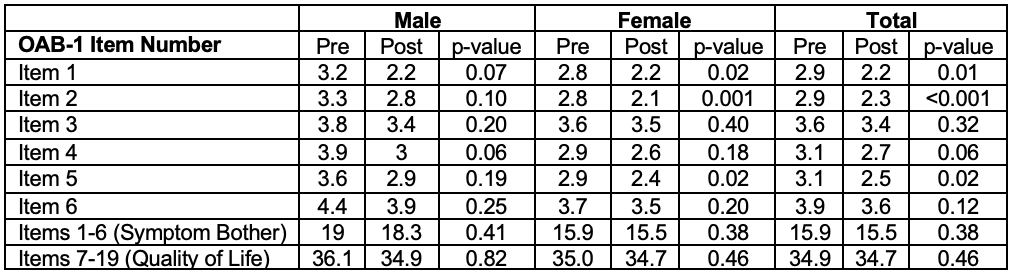
Introduction: Peripheral tibial nerve stimulation (PTNS) is a novel technique for treatment of overactive bladder (OAB), with demonstrated efficacy in reduction of OAB symptoms. We seek to evaluate efficacy of PTNS in self-reported reduction of OAB symptoms at a single academic urologic clinic. Methods: Single institution cohort was performed of PTNS therapy in men and woman with refractory OAB symptoms. Overactive bladder questionnaire short form (OAB-q SF) was used to track urinary symptoms after each session of PTNS. Descriptive analysis was conducted on baseline characteristics. T-tests were used for continuous variables (or Wilcoxon signed-rank tests, as appropriate). Results: 138 patients (87 women and 51 men) underwent PTNS placement during study period. Median (IQR) PTNS treatments was 11 (6-12) sessions and 56 patients (40.6%) underwent 12 or more sessions. 82 patients (59.9%) had failed previous medical therapy and 97 (70.8%) had failed previous behavioral therapy. Of men, 30 (58.8%) were on concurrent alpha blocker therapy. Pre-procedure OAB-q SF data was available for 88 patients (female, male) and post-procedure data was available for 28 patients. When comparing OAB-q SF responses before and after treatment, no difference was seen for total symptom bother score (survey items 1-6) for all participants (15.9 vs. 15.5, p=0.38), female participants (15.9 vs. 15.5, p=0.38) or male participants (19.0 vs. 18.3, p=0.41). No difference was seen for total HRQOL (survey items 7-19) for all participants (34.9 vs. 34.7, p=0.46), female participants (35.0 vs. 34.7, p=0.46) or male participants (36.1 vs. 34.9, p=0.82). Significant differences were seen for specific items within the symptom bother section of survey including item 1 “Uncomfortable urge to urinate” (female pre 2.8 vs. post 2.2, p=0.02), item 2 “Sudden urge to urinate with little or no warning” (female pre 2.8 vs. post 2.1, p=0.001) and item 5 “Waking up at night because you had urge to urinate” (pre 2.9 vs. post 2.4, p=0.02). No difference was seen for any survey items within male cohort. Conclusions: In real-world cohort of patients with OAB, PTNS has limited impact on improvement in self-reported symptom bother and quality of life. SOURCE OF Funding: None