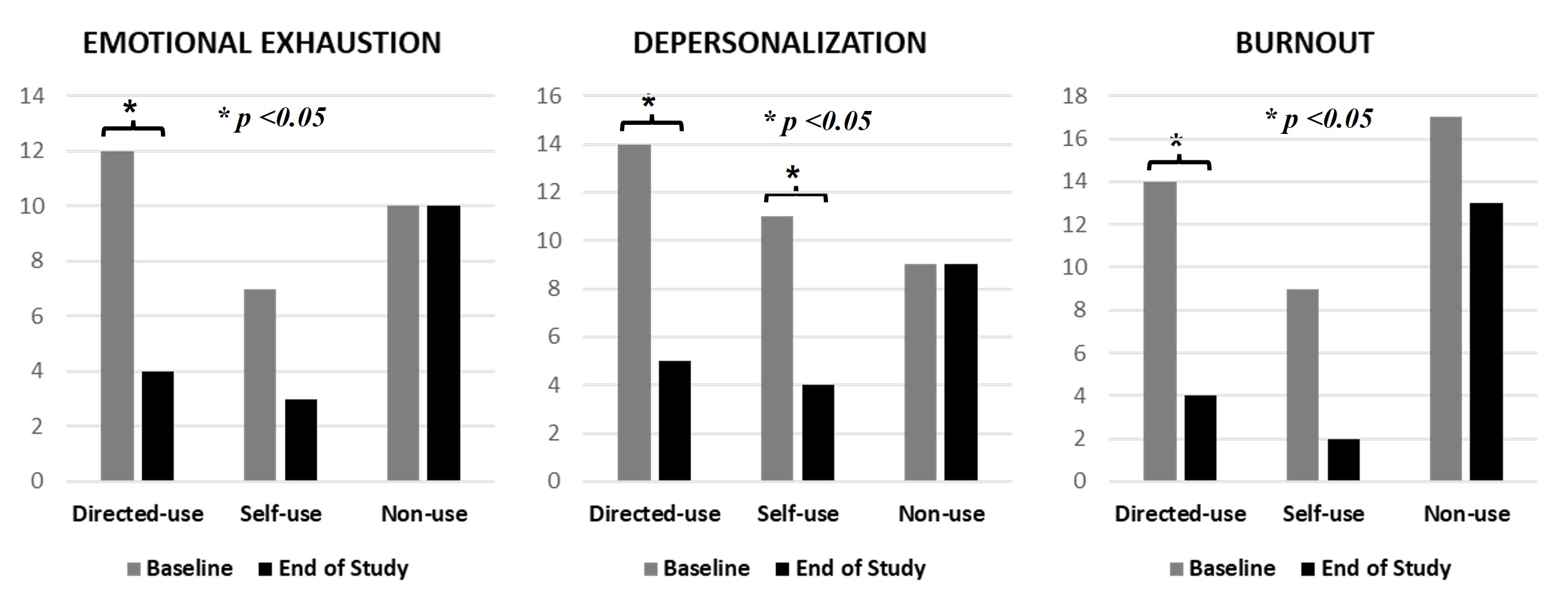
Introduction: Urology has among the highest burnout rates of all medical specialties. Burnout has been linked to adverse clinical and professional outcomes, and targeted interventions to reduce burnout are urgently needed. Headspace is a mindfulness and mental well-being app that has been shown to improve wellness among health care workers. We aimed to characterize the impact of an app-based intervention on burnout reduction among urology clinicians Methods: In this randomized clinical trial (NCT05036356), urologists, trainees, advanced practice providers, and nurses in an academic urology department were enrolled to use the Headspace app during a 6 month study period. For the first 3 months, participants were randomized to 1 of 2 arms: a structured Directed Use (DU) program of app activities targeting known sources of burnout in the department; or a Self Use (SU) program in which participants were free to use the app ad lib. In the second 3 months, all participants were free to continue using the app ad lib. Participants were surveyed at 0 and 6 months using the validated 2-item Maslach Burnout Inventory to assess emotional exhaustion and depersonalization, and the Professional Fulfillment Index to measure burnout. Intragroup results were analyzed using McNemar’s test Results: Of the 66 enrollees randomized to the DU (n=32) and SU (n=34) arms, 18 DU and 21 SU participants completed the study, while the remaining participants subsequently never used the app and were analyzed separately as a Non Use control group (NU, n=27). DU participants experienced statistically significant reductions in all 3 burnout metrics (Figure). Emotional exhaustion decreased 42% in the DU group (p=0.03) and 17% in the SU group (p=0.6). Depersonalization decreased 48% in the DU group (p=0.02) and 31% in the SU group (p=0.02). Overall burnout decreased 51% in the DU group (p < 0.01) and 32% in the SU group (p=0.06). There was no significant change in any of the burnout metrics for the NU group. Professional fulfillment increased 21% in the DU group and 17% in the SU group, but neither was statistically significant Conclusions: This app-based intervention led to significant, sustained reductions in emotional exhaustion, depersonalization, and professional burnout. The promising findings of this pilot intervention merit scaled validation studies SOURCE OF Funding: None