Session: PD29: Bladder Cancer: Epidemiology & Evaluation II
PD29-01: The Hematuria Cancer Risk Score: A validation study demonstrating reduction in the number needed to investigate while preserving fidelity of cancer detection
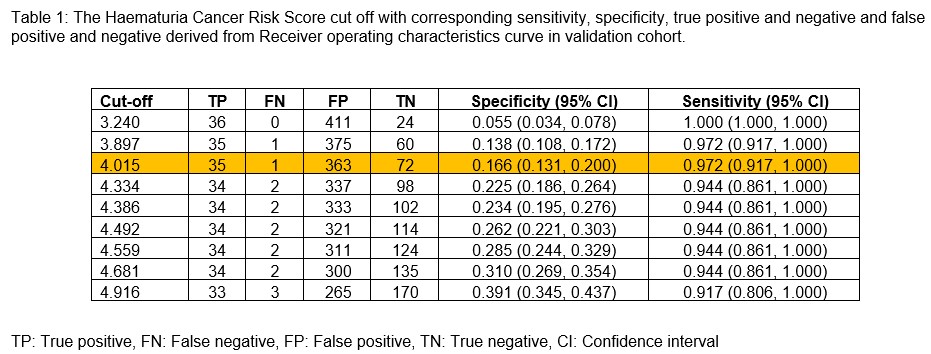
Introduction: Hematuria is a cardinal symptom of urinary tract cancer and is used to advocate selective screening in this patient cohort. Guidelines vary on who should be investigated following a presentation of hematuria. We report the external validation of the Hematuria Cancer Risk Score (HCRS), a risk assessment tool, to better selective patients who should receive hematuria investigations. Methods: The HCRS was developed previously using a prospective cohort of 3,539 patients investigated for hematuria across 40 UK hospitals (DETECT 1; ClinicalTrials.gov: NCT02676180). The external validation cohort consisted of 500 consecutive patients referred to secondary care under an accelerated access pathway for hematuria investigations. Patients included received cystoscopy and upper tract imaging. A diagnosis of cancer was based on histological confirmation. A predetermined cut-off was determined for the validation cohort. Results: Of 500 patients in the validation cohort, 471 patients were included for analysis. Overall, 36 patients had a diagnosis of urinary tract cancer (33 [7.0%] bladder cancers, 3 [0.6%] upper tract cancers). Median HCRS was higher in patients diagnosed with bladder cancer compared to non-cancer patients (6.118 (IQR: 5.741-6.601) versus 5.265 (IQR: 4.423-6.142) p<0.001). Validation of the HCRS achieved a good discrimination with an AUC of 0.727 (95% CI 0.650–0.804) in the validation cohort. Utilizing a cut-off score of 4.015 allowed identification of 35 tumours (97%) while simultaneously reducing the number of patients undergoing investigation by 72 patients (15%). This includes all three patients with upper tract tumours (1 RCC, 2 UTUC). Only a G1 Ta bladder cancer was missed. Conclusions: We report the HCRS offers good discriminatory ability in identifying patients who would benefit from investigation for hematuria. As many as 15% of patients referred for hematuria investigations could be spared from invasive procedures safely, leading to healthcare cost savings. The simplicity of the model allows for easy clinical adoption and can aid both patient and physician decision making. SOURCE OF Funding: DETECT I trial was funded my the Medical Research Council