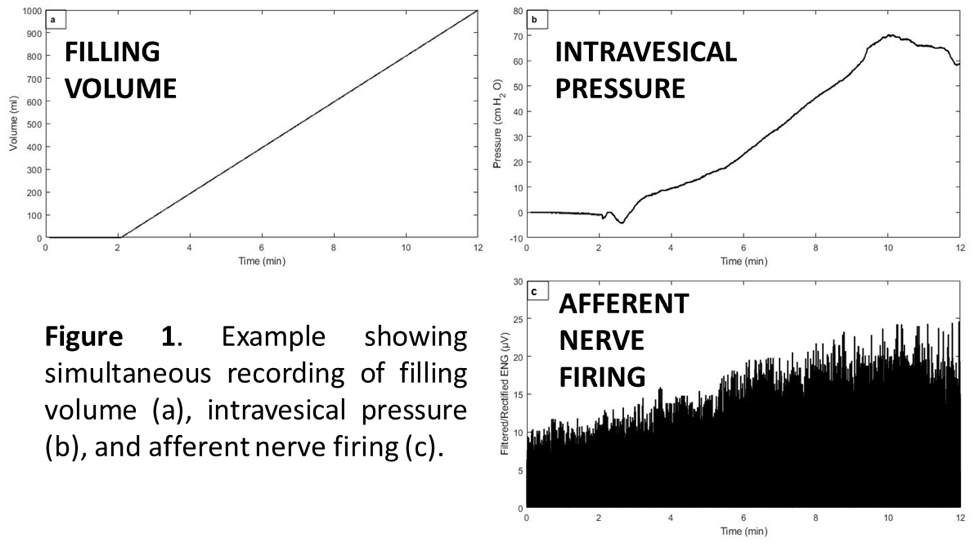
Introduction: While urodynamics testing is routinely used to evaluate voiding dysfunction, the tests are expensive, invasive, poorly reproducible, and prone to artifacts. There is a pressing need to develop next-generation urodynamics. The purpose of this study was to develop an ex-vivo porcine bladder model to measure afferent pelvic nerve signaling that can be used as a platform for novel urodynamic tools. Methods: Porcine bladders with attached ureters and vascular supply were harvested from local abattoirs and perfused with physiologic buffer. Micro-hook electrodes were attached to the pelvic nerve on the posterior of the bladder and electroneurogram (ENG) signals were recorded at 20KHz. Each bladder was filled with 1 liter of saline over 10 minutes using standard urodynamics equipment which simultaneously recorded intravesical pressure (Figure 1A). Nerve amplitude was calculated as the area under the curve (AUC) for each minute and nerve firing rate was calculated as number of nerve spikes (above baseline threshold) per minute. At the conclusion of the experiment, samples of the nerve were collected and processed for histological analysis (H&E and S100 stains). Results: A total of 9 pig bladders were used. A pathologist confirmed the presence of nerve in all adequately processed samples. Vesical pressure, nerve firing rate, and nerve amplitude were all found to increase with bladder filling (Figure 1B). During filling tertiles (low fill: min 1-3, med fill: min 4-6, and high fill: min 7-10), pressures were 0.22± 0.04, 0.38±0.05 and 0.72±0.07 (cmH20). Nerve firing rates were 0.08±0.03, 0.31±0.06 and 0.43±0.04 spikes/minute, respectively, and nerve amplitudes were 0.11±0.06, 0.39±0.06 and 0.56±0.14 µV. There were strong relationships between average normalized pressure values and averaged normalized nerve firing rate (r2= 0.66) as well as average normalized nerve amplitude (r2= 0.8). Conclusions: The ex-vivo perfused porcine bladder model can reproducibly measure afferent nerve activity that correlates with intravesical pressure during filling. This protocol can be used as a preclinical model for the development of next-generation urodynamics technologies and could potentially be used as a surrogate measure of bladder sensation. SOURCE OF Funding: NIH R01-DK101719 & VCU Endeavour Legacy Foundation