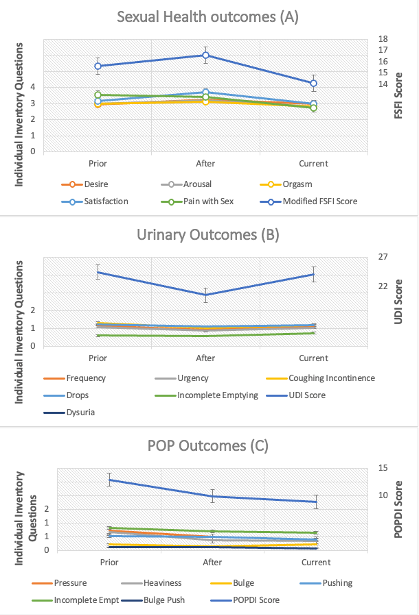
Introduction: Obese women are more likely to experience bothersome urinary and sexual symptoms but the effect of bariatric surgery on these outcomes is poorly understood. We aim to describe how bariatric surgery impacts women’s urinary, sexual, and pelvic organ prolapse (POP) outcomes. Methods: Bariatric surgery patients at University of California, San Francisco between 2009 and 2021 participated in a survey examining pelvic organ prolapse, sexual, and urinary health. Validated questionnaires measured each outcome: a modified version of the Female Sexual Function Index (FSFI), Pelvic Organ Prolapse Distress Inventory 6 (POPDI-6), and Urinary Distress Inventory 6 (UDI-6). All questions asked referenced three time points: before surgery, “at best” 4 weeks after surgery, and at the time of survey. Uni- and multivariate analyses were used to report the odds of patient factors associated with changes in outcomes of interest. Results: Of 539 potential participants, 463 were women and 116 (25%) had complete survey data. The mean UDI-6 score was 24.5 prior to weight loss surgery, 20.6 after surgery, and 24 at the time of survey. Predictors of improvement of UDI-6 from pre- to best included no past use of hormone therapy (OR= 1.6, p=.069) and better UDI score prior to surgery (OR= 1.036, p=.004). The mean score for the FSFI component "satisfaction" was 3.14 prior to surgery, 3.63 after surgery, and 3.1 at the time of survey. Women who were post-menopausal were more likely to improve in FSFI from pre- to best (OR=3.99, p=.012). The mean POPDI-6 score was 12.9 prior to surgery, 9.9 after surgery, and 8.9 at the time of survey administration. A predictor of POPDI-6 improvement from pre- to best was better prior POPDI score (OR=1.33, p<.001). Conclusions: Women who undergo weight loss surgery experience benefits in urinary, sexual, and prolapse outcomes immediately following surgery, with a trend toward a return to pre-operative baseline function thereafter. Those with worse pre-operative function across all measures showed the least benefit from weight loss surgery. SOURCE OF Funding: None.