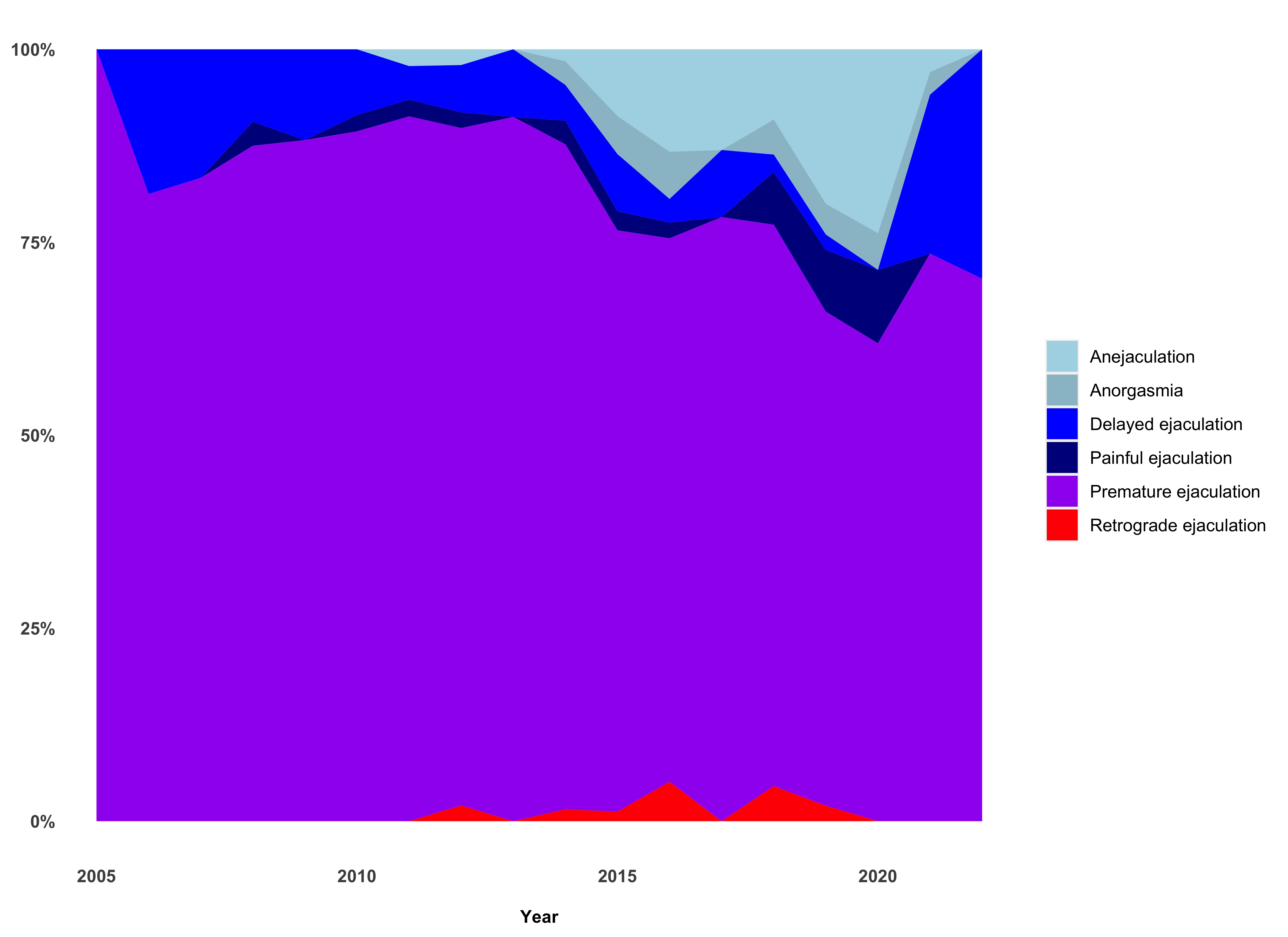
Introduction: The spectrum of ejaculatory disorders (DoE) includes numerous complaints often challenging to manage. We sought to describe the prevalence and the characteristics of men consecutively presenting with DoEs at a tertiary referral academic center over a 17-yr time-frame. Methods: Data from 761 men presenting for DoE as their primary complaint between 2005-2022 were analysed. Baseline clinical and socio-demographic characteristics were collected. All patients completed the International Index of Erectile Function (IIEF) at first assessment. Men were stratified according to their DoE into: anejaculation (AE); anorgasmia (AO); retrograde ejaculation (RE); delayed ejaculation (DE); painful ejaculation (PE); premature ejaculation(PreE); and, multiple ejaculatory complaints (ME) (defined according to EAU guidelines). Descriptive statistic was used to assess differences among the groups and logistic regression analysis using year at presentation as covariate was used to assess statistical significance for the shown trends. Results: Overall, 49(6.4%) men complained for AE, 18(2.4%) for AO, 11(1.4%) for RE [of these, 8(72.7%) had been submitted to surgery for BPH], 62(8.1%) for DE, 19(2.5%) for PE, and 602(79.1%) for PreE. Over time we depicted a decrease in the percentage of men presenting with PE as their primary complaint as compared with the other DoEs (OR:0.98; 95CI% 0.85-0.94; p<0.001) (Figure). Overall, BMI, sexual hormone profile and comorbidities were similar amongst groups, whilst median age was higher for those with RE (67.0 years [IQR 62.5, 70.5]) and lower for those with PE (44.0 years [34.0, 54.0]) (p < 0.001). Patients with a history of AE, RE and AO more frequently had diabetes (either type I or II) and a history of cardiovascular diseases (p < 0.001). The proportion of men with concomitant erectile dysfunction ranged from 31.6%(6) in men with PE to 90.9%(10) of those with RE. IIEF-orgasmic function and IIEF-overall satisfaction domains were significantly lower for those presenting with AE and AO as compared with all other DoEs. Conclusions: The rates and characteristics of the DoEs in the real-life clinical setting over the last 17-yr time frame have changed. The proportion of unusual DoEs has increased whilst the prevalence of PE has decreased throughout the analyzed period. SOURCE OF Funding: None