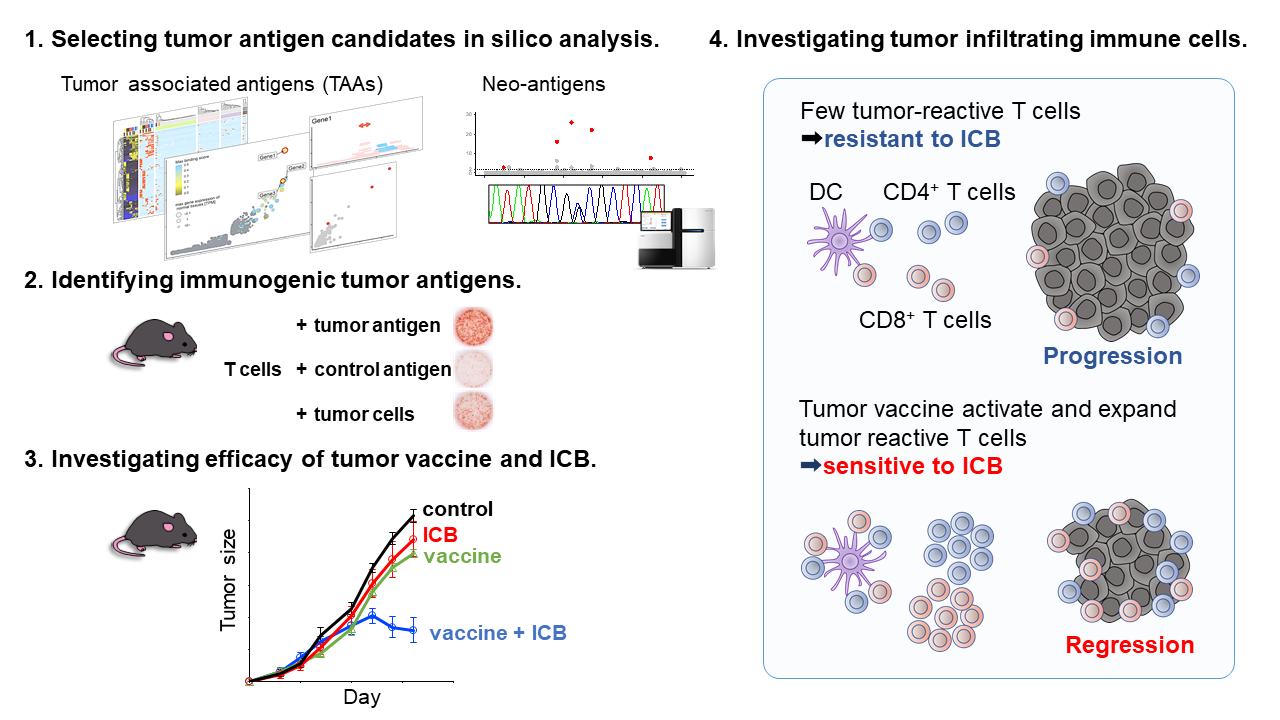
Introduction: Progressive and chemoresistant bladder cancer is problematic because of the poor prognosis. Immune checkpoint blockade (ICB) has exhibited drastic anti-tumor efficacy in some patients, but the response rates were limited. Therefore, to improve efficacy of immunotherapy for refractory cancer, we have tried to develop a combination immunotherapy of tumor antigen vaccine and ICB in tumor-bearing mouse models. Methods: We identified genes highly expressed in tumors but not in normal tissues by comparing RNA-seq data of mouse bladder cancer MB49, cisplatin-resistant MB49-CR, and lymphoma RMA cell lines, all of which are refractory to ICB, with datasets of 26 normal mouse tissues. Subsequently tumor-associated antigens-derived peptides predicted to have high binding affinities to MHC-I and -II molecules were identified by prediction algorithms. We also selected immunogenic and cancer-specific mutated Neo-antigenic peptides. MB49, MB49-CR, or RMA bearing mice were treated with these peptides and ICB. Finally, we investigated tumor infiltrating immune cells by flow cytometry, T cell receptor (TCR) repertoire analysis and RNA-seq of inoculated tumors. Results: In 50-80% of mice pre-immunized with identified peptides, growths of MB49 and RMA inoculated s.c. were prevented and these immunized mice rejected re-transplanted tumors. Furthermore, combination therapy of these peptide vaccines and ICB synergistically inhibited tumor-growth of MB49-CR, MB49 and RMA indicating that the combination immunotherapy enhances therapeutic efficacy to treat refractory cancers. We also observed combination therapy with MHC-I antigen vaccination and ICB synergistically increased limited CD8+ TCR-alpha and beta genes in tumors, suggesting increased antigen-specific tumor-infiltrating CD8+ T cells. Furthermore, combination therapy with MHC-I/II antigen vaccine and ICB synergistically induced drastic changes of various types of tumor-infiltrating immune cells such as CD8+ T cells, CD4+ type 1 helper T cells, regulatory CD4+ T cells and natural killer cells. Conclusions: These results suggest that the combination immunotherapy described above shapes tumor-infiltrating immune cells and enhances therapeutic efficacy to treat refractory cancer. SOURCE OF Funding: This work was supported by KAKENHI.