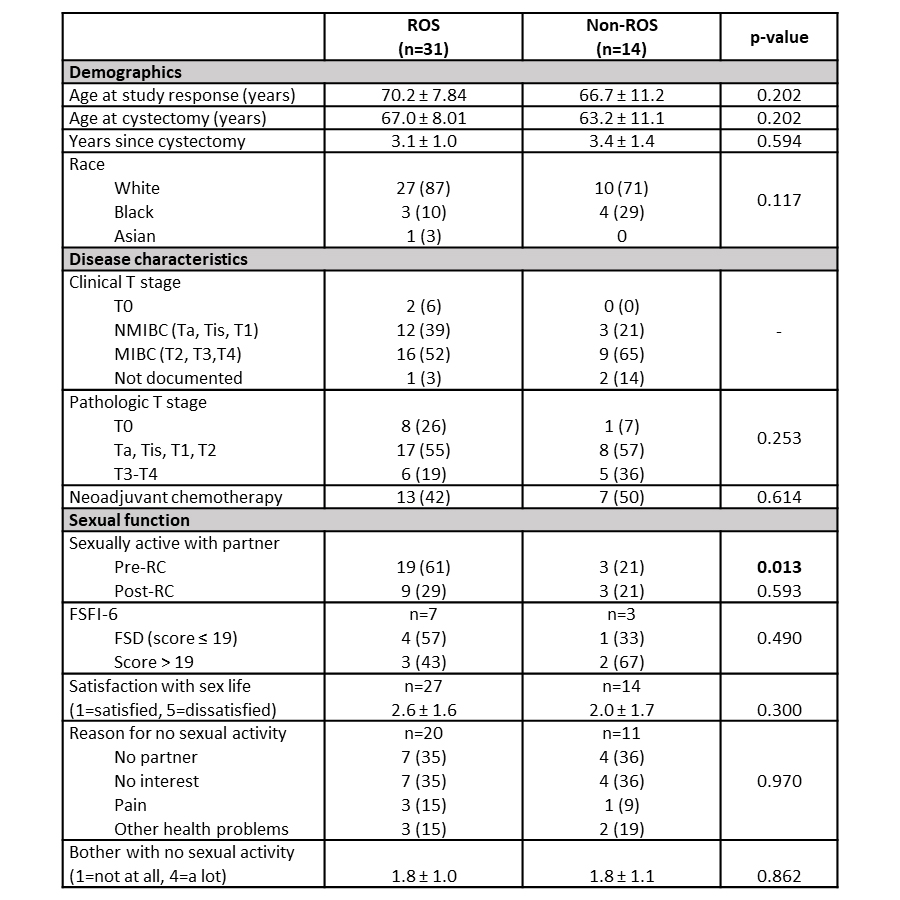
Introduction: Given recent data, reproductive organ sparing (ROS) radical cystectomy is a safe and effective treatment for bladder cancer in select women. In this study, we sought to better understand sexual function outcomes in females who underwent a ROS versus a non-reproductive organ sparing (non-ROS) radical cystectomy for the treatment of bladder cancer. Methods: A cross-sectional questionnaire was administered in April 2022 to eligible participants selected from a retrospective single-institution cohort of female patients with a primary bladder malignancy who underwent radical cystectomy between 2016-2020. The study questionnaire included the short form of the Female Sexual Function Index (FSFI-6), a validated evaluation tool for diagnosing female sexual dysfunction (FSD) (score = 19). Satisfaction with sex life was reported on a Likert scale with 5=dissatisfied and 1=satisfied. Bother with lack of sexual activity was reported as 4=a lot and 1=not at all. Results: Among eligible patients (n=70), 45 women (64%) completed the questionnaire on average 3.1 ± 1.0 and 3.4 ± 1.4 years post-cystectomy for the ROS and non-ROS groups, respectively (p=0.59). Advanced-stage bladder cancer (=pT3) was not statistically more prevalent in non-ROS (36%) compared to ROS patients (19%, p=0.25). Before surgery, significantly more women were sexually active in the ROS group (61%) than non-ROS (21%, p=0.01); however, post-cystectomy, this difference was not observed (29% vs. 21%, p=0.59). There was a trend towards more FSD among ROS patients by FSFI-6 (57% vs. 33%, p=0.49). In both the ROS and non-ROS groups, patients who were not sexually active reported low levels of bother regarding the absence of sexual activity (1.8 ± 1.0 vs. 1.8 ± 1.1, p=0.86). Conclusions: Within our limited cross-sectional cohort, we identified a higher prevalence of FSD in the ROS group, although this finding was not statistically significant. Consideration of patient-specific values when discussing post-operative sexual function is essential as most non-sexually active patients denied feeling concerned by a lack of sexual activity. Further research is needed to better understand the factors impacting post-cystectomy sexual function in women and to investigate interventions targeting the psychoeducational components of sexual health. SOURCE OF Funding: None