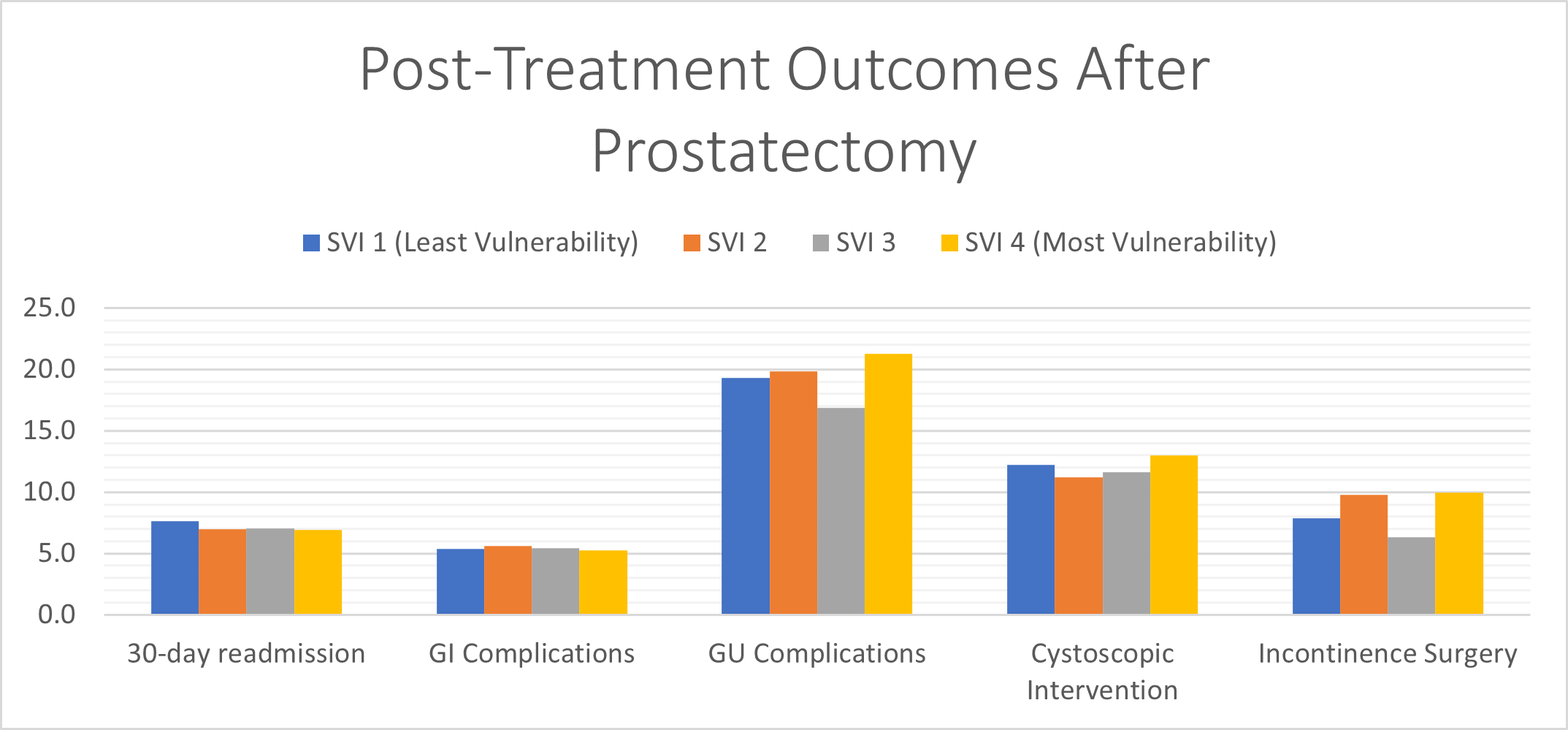
Introduction: Adverse social determinants of health (SDOH) contribute to poor quality of care across the cancer care continuum in prostate cancer (PCa), however the impact on post-treatment outcomes and longer-term survivorship remains unknown. In this study, we investigate the association of community-level SDOH as measured by the Centers for Disease Control and Prevention Social Vulnerability Index (SVI) with post-prostatectomy outcomes in patients undergoing radical prostatectomy (RP) for PCa. Methods: We used Medicare claims data to perform a retrospective cohort study of men >65 years with newly diagnosed PCa treated with RP between 2015-2019. SVI was abstracted and linked to each beneficiary at the county-level and categorized into quartiles (i.e., least vulnerable to most vulnerable). 30-day readmission, gastrointestinal (GI) complications, and genitourinary (GU) complications were compared across SVI quartiles. Group comparisons were tested with chi-squared analyses. Results: We identified 26,977 men who underwent RP. Those residing in counties with the most vulnerability had similar rates of 30-day readmissions and GI complications/interventions (p>0.05), but significantly higher rates of GU complications/interventions (p < 0.01). In terms of urinary function, these men had higher rates of surgery for incontinence (p < 0.01). Conclusions: In a large cohort of Medicare beneficiaries with newly diagnosed PCa, men residing in higher SVI counties experienced higher rates of GU complications and related surgical interventions after RP and were also more likely to undergo incontinence surgery. Community-level SDOH impact quality of PCa care, including perioperative outcomes, long-term side effects after prostatectomy, and receipt of appropriate interventions. SOURCE OF Funding: Prostate Cancer Foundation