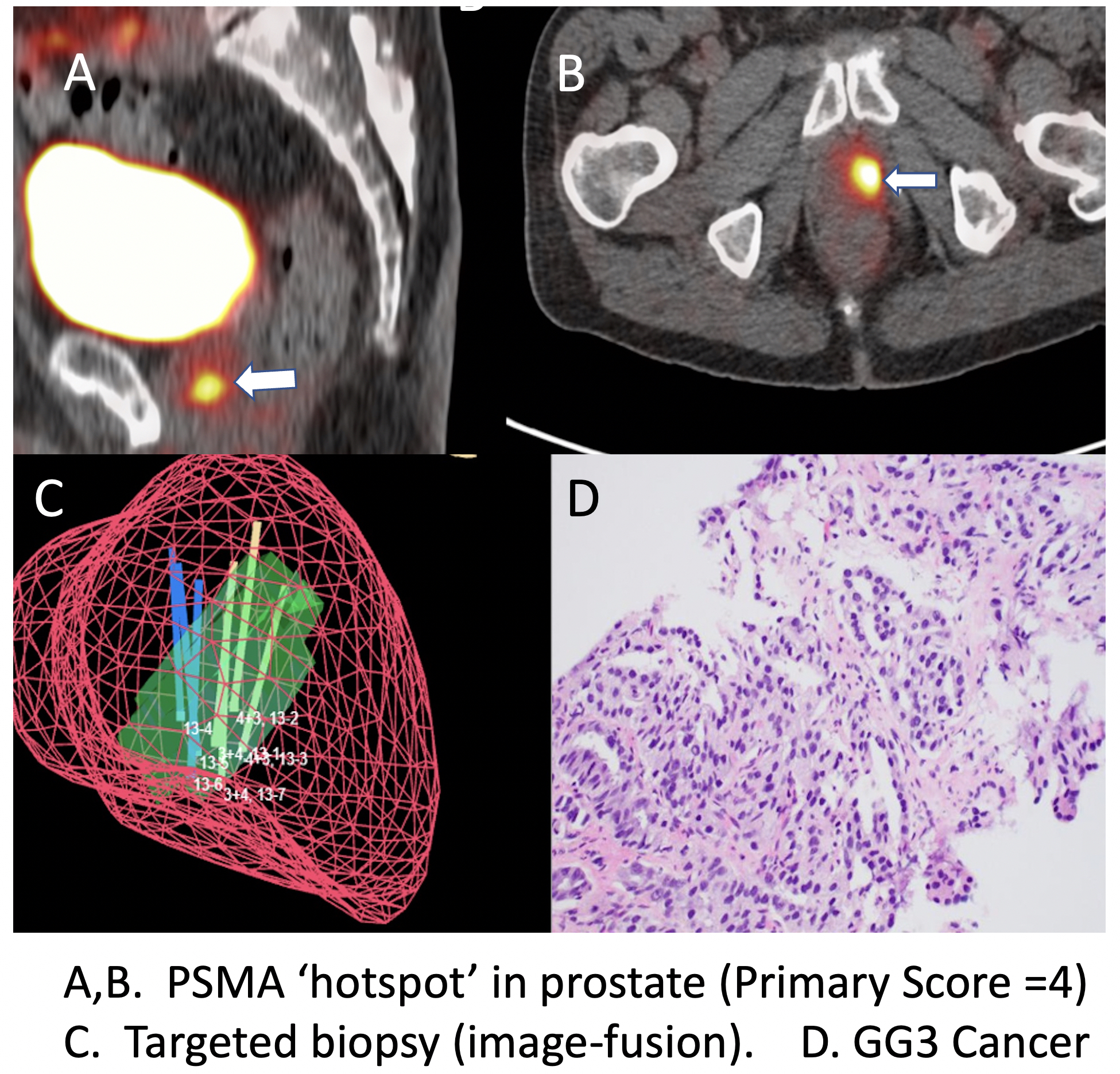
Introduction: PSMA scanning is a most accurate method for detection of metastatic PCa. PSMA scanning may also reveal intra-prostatic cancer (PCa). Since MRI-guided biopsy (MRGB) may miss 15-20% of clinically-significant csPCa (=GG2), we postulated that biopsy targeting PSMA foci in the prostate (PSMA-guided biopsy, PSMA-GB) might provide PCa detection in cases where MRGB failed. Methods: 48 men with negative MRI-guided biopsy (MRGB), but continued suspicion of PCa (increased PSA density), underwent PSMA scanning within 6 months of MRGB. In the 23 with focal PSMA uptake in the prostate, a PSMA-GB was performed using PET/CT images instead of MR images for fusion with ultrasound. 4-8 biopsy cores were taken from each PSMA ‘hot spot’(Figure). Method of PSMA-GB was identical to MRGB, but employed US fusion with PET/CT instead of MRI, as detailed in the original case report (PMID: 28607878). Method of Ga-PSMA image acquisition via PET/CT scanning has been reported (PMID: 30920593). Contouring of PSMA foci within the prostate was via Profuse software by co-author J.C. Image fusion and trans-rectal targeted biopsy was via Artemis device (LSM). Detection rate of csPCa by PSMA-GB was primary endpoint. Results: Among the 23 study patients, mean age = 67 yrs (Range: 53-81); prostate volume = 58.5cc (22.7-109.3); PSA= 13.8 ng/ml (4.5- 34.8); PSA density = 0.245 ng/ml/cc (0.073- 0.57). At first biopsy (MRGB), PIRADS score = 0-2 in 19 men and >3 in 4. PSMA-GB was successfully completed in all 23. Overall detection rate of csPCa was 15/23 (65.22%): GG2 in 6, GG3 in 6, GG4 in 2, and GG5 in 1. Median SUVmax (standardized uptake value) was 12.5 (5.8-28.7) in men whose PSMA hotspot revealed csPCa vs 5.8 (3.2-10.4) in men with negative PSMA-GB. Of 12 men whose PSMA focus was highly suspicious, i.e., Emmett’s Primary Score of 4 or 5 (PMID: 34373749 ), 11 had csPCa. Conclusions: Prostate biopsy, which targets PSMA ‘hot spots’ via PET/CT-US fusion, often leads to detection of csPCa missed by MRI-guided biopsy. SOURCE OF Funding: Jean Perkins Foundation; NCI-R01 CA 195505; and Department of Nuclear Medicine, UCLA.