MP24-11: Real-world assessment of the 2-second rule for Qmax measurement during uroflowmetry based on patient-generated data using an audio-based smartphone application
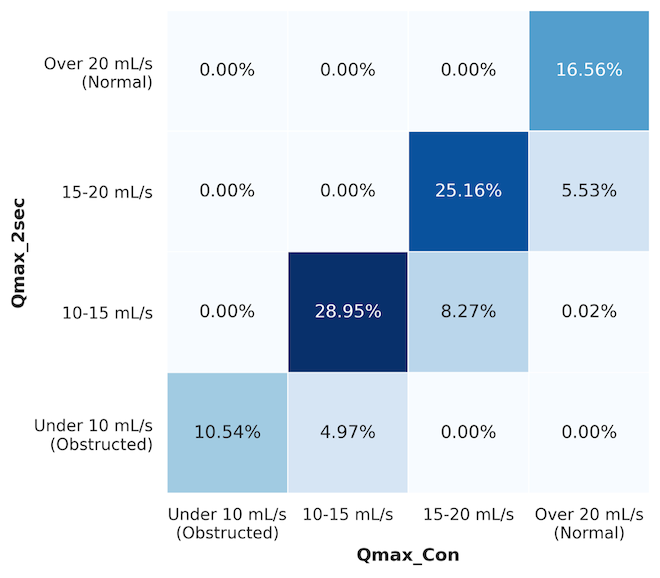
Introduction: Maximum flow rate (Qmax) is a key measurement during uroflowmetry workup for lower urinary tract symptoms. However, it is well known that artifacts occurring during urination introduce errors in Qmax. The “2-second rule” is a method to correct artifact and measure the highest flow rate maintained for at least 2 seconds (Qmax_2Sec). We attempt to analyze the impact of adjusted Qmax in patient diagnosis by comparing Qmax_2Sec and conventional Qmax (Qmax_Con) based on a large set of data generated using an audio-based uroflowmetry smartphone application. Methods: 510 men who visited the urology clinic at University of Texas Southwestern Medical Center between Aug 2020 and May 2022 downloaded the “proudP'' application on their smartphones. During urination, the patient places his phone 3 feet away from the toilet and urinates directly into the toilet. The device captures sound and generates a uroflowmetry flow curve and parameters including Qmax, using a proprietary algorithm. Qmax_2Sec is computed from the flow curve in accordance with the definition of the 2-second rule. A total of 24,225 proudP results from 475 volunteers were analyzed after excluding 21 subjects with unknown birth dates, 1,869 inapplicable recordings, and 5,137 recordings with voided volume (VV) less than 150mL. Results: Among 24,225 proudP cases, 49.6% of cases demonstrated artifact (?Qmax_Con-Qmax_2Sec) greater than 1mL/sec. Most were in the range of ?1.0-1.9mL/s (41.2%) while 8.5% and 2.4% of cases showed artifact of >2mL/s and >3mL/s, respectively. Application of Qmax_2Sec downgraded 18.8% of cases to a category worse than that determined by Qmax_Con, suggesting potential under-diagnosis of obstruction. While application of Qmax_Con identified 33.9% and 10.5% of potentially obstructed (10mL/s-15mL/s) or obstructed ( <10mL/s) cases, respectively, those increased to 37.2% and 15.5%, respectively, when Qmax_2Sec was applied. Conclusions: An innovative audio-based uroflowmetry application is subject to similar artifacts as with in-office uroflowmeters. This leads to overestimation of Qmax and false increases in the mean/median which may impact clinical care. In the case of the application, the artifact can be electronically corrected applying the 2-second rule. SOURCE OF Funding: n/a