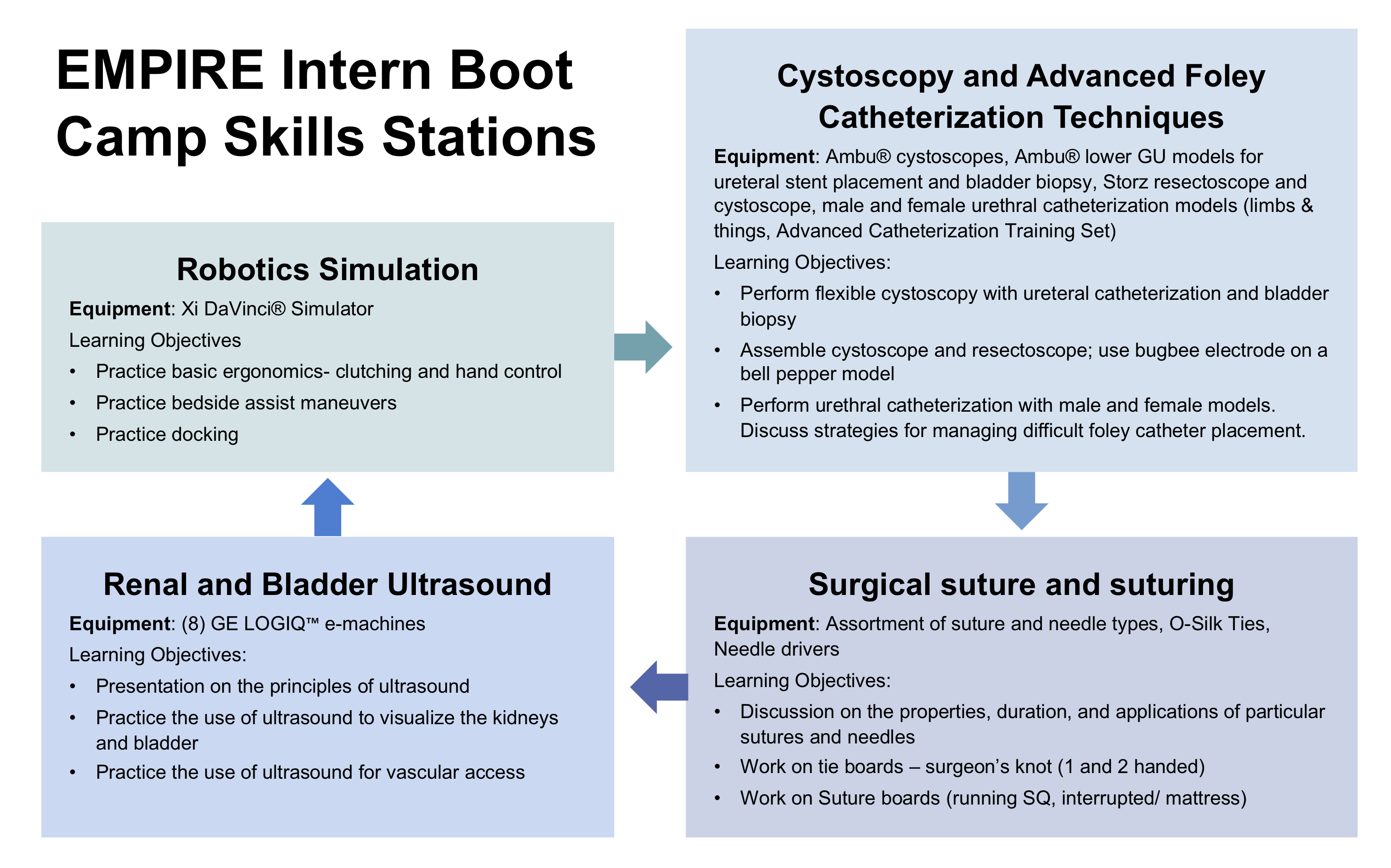
Introduction: In order to increase junior resident proficiency and improve patient safety, simulation-based procedural trainings, or bootcamps, have become an emerging educational tool. Our goal was to assess the viability and efficacy of a multi-institutional, predominantly skills-based bootcamp for junior urology residents. Methods: First and second year urology residents from the New York Section of the American Urologic Association (AUA) attended a live, procedurally-focused EMPIRE (Educational Multi-Institutional Program for Instructing REsidents) Boot Camp. The curriculum included simulation-based trainings including urethral catheterization, cystoscopy, renal and bladder ultrasound, and robotic simulation (Figure 1). Faculty from 10 institutions helped lead the various exercises. The seminar also included a didactic on urologic emergencies. A questionnaire assessing the experience was distributed to all faculty and resident participants immediately following the course. Results: Twenty-nine junior residents and 16 faculty members participated in this course. Following completion, 11 faculty (69%; 11/16) and 23 trainees (79%; 23/29) submitted an evaluation. On a 5-point Likert scale of relative efficacy, with a higher number being more favorable, the score for each activity ranged from a mean of 4.39 ± 0.64 for the renal bladder ultrasound station to 4.83 ± 0.38 for the urethral catheterization workshop. The majority of trainees “strongly agreed” the event was fun and engaging (20/23; 4.83 ± 0.48) and felt better prepared for upcoming residency rotations (20/23; 4.78 ± 0.59) after the boot camp. Over 90% (21/23; mean 4.91 ± 0.28) strongly agreed the course provided a high-yield overview of urologic emergencies. 73% (8/11) of faculty rated the event as “excellent” for skills training. When asked about skills sessions for interns at their institutions in prior years, 45% (5/11) faculty noted no prior advanced skills sessions were offered. Conclusions: A skills-based collaborative urology boot camp is feasible and is perceived to be effective in preparing junior trainees for residency in a multi-institutional environment. Multi-institutional efforts such as these can help ensure trainees have equitable access to fundamental training experiences. SOURCE OF Funding: None