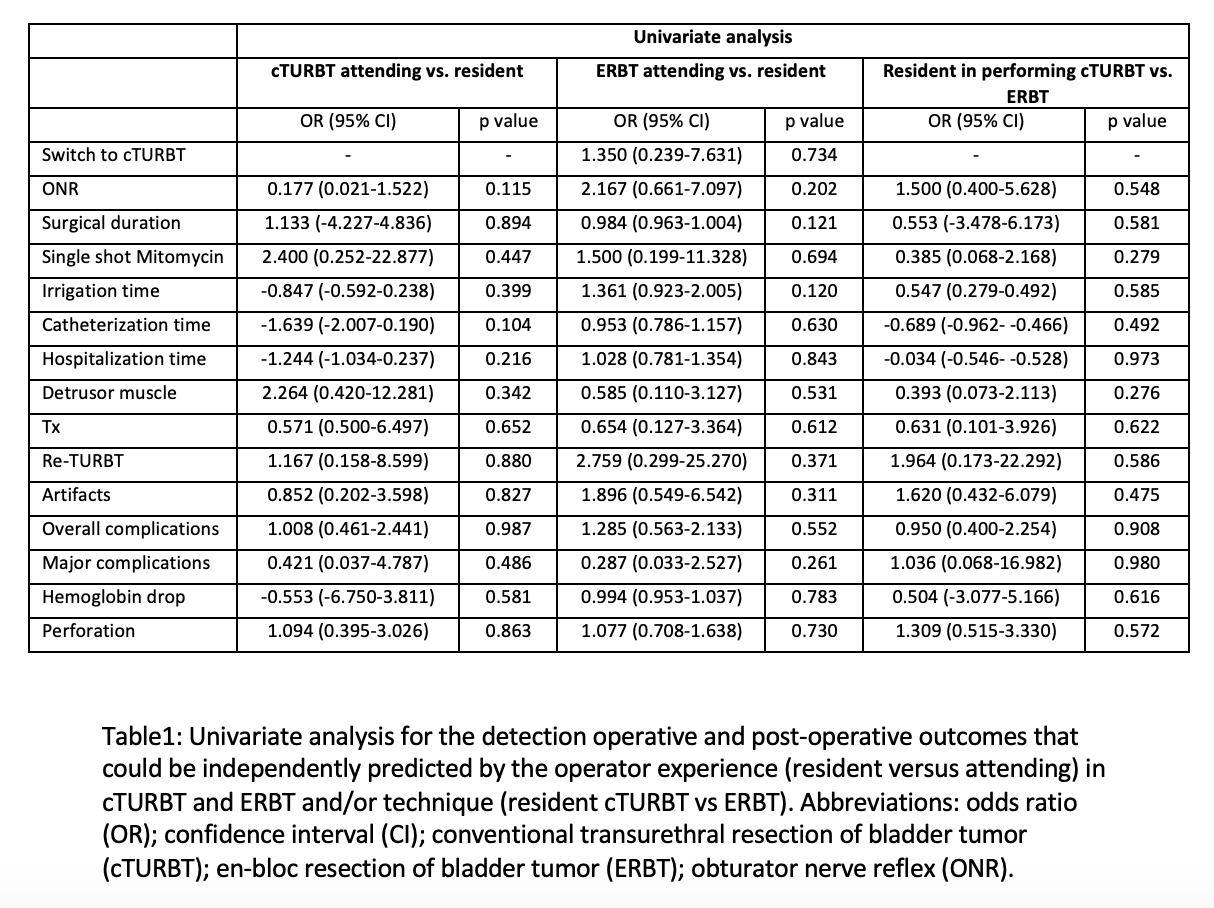
Introduction: Urology residents training programs are uneven and often unsatisfactory for the residents. Despite, the exposure to surgical procedures is a crucial step in their training, patients’ safety is of central importance. The significance of resident mentoring should not be overstated and trainees should be mentored by training-trained urologist even in case of common procedures such as the conventional or en bloc transurethral resection of bladder tumor (cTURBT/ERBT). The goal of this study is to demonstrate the comparability in performance cTURBT and ERBT between urology residents and attendings. Methods: This study is a subanalysis of a prospective, randomized trial enrolling patients diagnosed with BC and undergoing endoscopic intervention. Inclusion criteria were: tumor size of =3 cm, and =3 lesions, and no sign of muscle invasion and/or ureteral involvement. The trial (NCT04712201) was approved by the Institutional Review Board (2017/09c). Surgeons were either urology attendings or supervised residents of the 3rd-5th year. Primary outcome was to compare surgical and post-operative outcomes in both groups. Linear and logistic regression analysis were used to find a correlation between surgical outcomes and surgical experience. Results: From 04/2018 to 06/2021, 300 patients met inclusion criteria and 248 (83%) of these underwent the assigned intervention. 200 (80.6%) patients were males and median (SD) age was 71.2 (11.2). 108 (44%) and 140 (57%) patients were submitted to TURBT and ERBT. 47 (19%) and 85 (34%) patients and 59 (24%) and 57 (23%) patients were treated by cTURBT and ERBT by urology attendings and residents, respectively. No statistical differences were found in terms of intra and post-operative outcomes (all p>0.05). Linear and logistic regression analysis are shown in Table 1 and were comparable for all variables (all p>0.05). Conclusions: Supervised urology residents do not put the patient at an increased risk of complications neither perform a suboptimal procedure. Resident mentoring is fundamental in order to reach comparable results in surgical outcomes and pathological diagnosis. A structured standardized program with trained trainers and proficiency evaluations are warranted to gain and maintain these outcomes across urology residency programs. SOURCE OF Funding: -