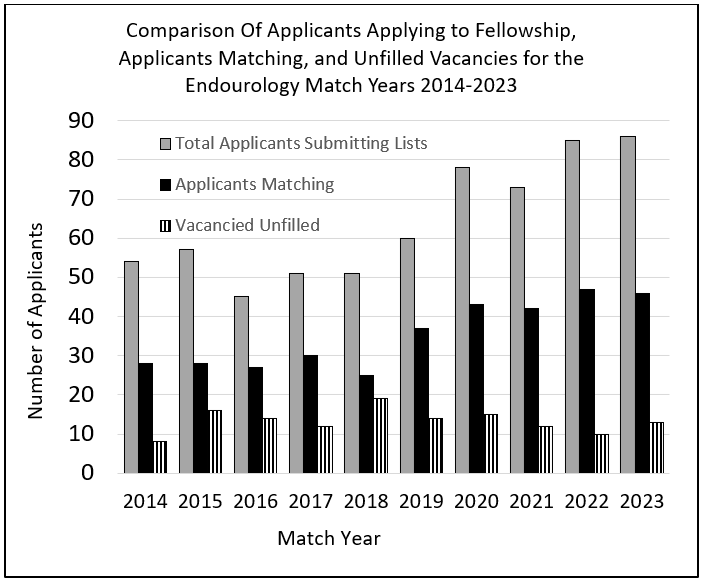
Introduction: The proportion of urology residents who choose to pursue fellowship training has steadily increased over the past decade. The Endourological Society fellowship match allocates fellowship positions for advanced endoscopic and minimally invasive surgical training in 83 programs across 5 continents. To understand contemporary trends in the global endourology training pipeline, we aimed to analyze results of the annual endourology fellowship match, conducted by the American Urologic Association. Methods: We analyzed endourology fellowship match statistics from the AUA for the match years 2014-2023 to characterize trends in application volumes, vacancies, applicants, and successful matches. Results: Over the past 10 years, the number of applicants entering the match increased from 54 to 86. In parallel with this increasing demand in fellowship training, the number if training opportunities has increased from 34 programs offering 36 positions in the 2014 match to 54 programs offering 59 positions in the 2023 match. Despite consistent excess of applicants relative to available positions, an average of 13 positions are unfilled each year (range 8-19) corresponding to 26% of available positions (range 18-43%). Of the potential reasons for this, applicant desirability did not appreciably change: an average of 75% of applicants (range 72%-80%) were ranked by programs each year. Increase in positions and applicants is occurring in parallel. For the prior 10 match cycles, programs received an average of 15 applications (range 14-18) and offered 7 interviews to applicants (range 6-9). Applicants consistently completed an average of 4 interviews (range 3-6). Finally, on average 75% of vacancies were filled by US graduating residents (range 55%-89%), compared to 17% by non-US-trained candidates and 8% by prior US graduates. The number of successful female candidates averaged 5 per year, increasing from 3 women in 2014 to 11 in 2023. Conclusions: Despite increasing applicant demand and global supply of endourology fellowship positions, only 3 out of 4 applicants are ranked by programs, and a relatively high proportion of vacancies go unfilled each year. Female and non-US-trained candidates remain underrepresented. Strategies to bolster the endourology training pipeline merit increased attention. SOURCE OF Funding: none to report

.jpg "Garrett Ungerer, MD photo")