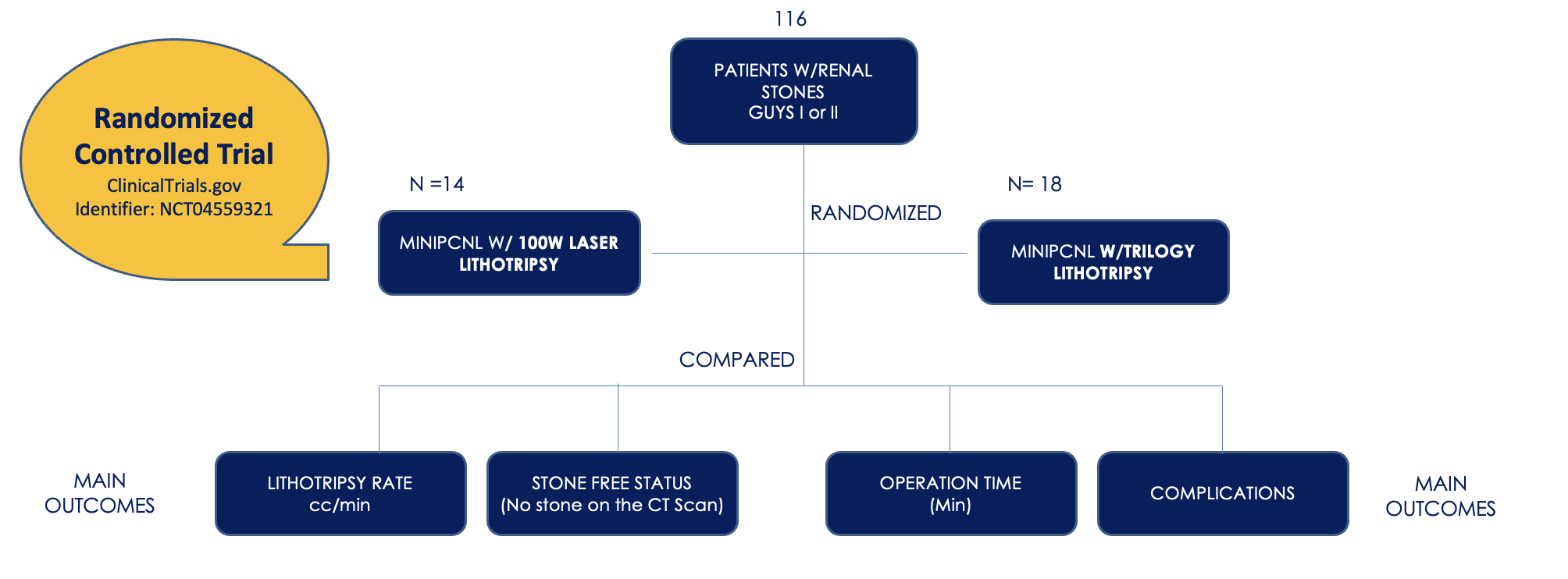
Introduction: The desire to reduce complications related to percutaneous access and morbidity related to tract size has led researchers to evaluate PCNL using smaller-caliber instruments. In this context, mini-PCNL has emerged. Furthermore, its efficacy and safety have been demonstrated at the cost of a lower stone-free rate. Currently, mini-PCNL has been performed with High power laser lithotripsy; therefore, it is convenient to make a comparison between the results of lithotripsy with Ho:YAG laser energy and the new LithoClast Trilogy EMS; and thereby determine which is the most effective method in the resolution of kidney stones through a miniaturized percutaneous tract. Methods: A total of 116 patients will be subjected to simple randomization with a table of random numbers; 58 patients will undergo a mini-PCNL with Trilogy EMS probe 1.5 mm (Group1), and the remaining will undergo mini-PCNL with 100 W laser lithotripsy (group 2). Comparing both groups will be made by evaluating lithotripsy rate, stone-free status, operation time, and complications. Results: We present the preliminary results of 32 randomized patients (18 in group 1 and 14 in group 2). Demographic data were homogeneous between both groups, including age, the side affected, BMI, maximum stone diameter, and stone volume (p values: 0.362, 0.221, 0.441, 0.569, and 0.120, respectively). Total fluoroscopy screening time was 24.3 and 26.4 seconds for groups 1 and 2, respectively (p: 0.547). Endoscopic stone-free status at the end of the surgical procedure was not statistically different in both groups (p: 0.394). Lithotripsy rate (195.09 sd 82.9 group 1 vs 202.7 sd: 99.38 for group 2) and operative time (94.28 sd: 34 for group1 vs 81.2 sd: 28.8 for group 2) were not statistically different in both groups (p: 0.815 and p: 0.268, respectively). The overall mean stone-free rate was 78.9 % (80.9% and 76.9%, respectively, with a p-value: of 0.371). The complications rate was similar in both groups (5.6 vs. 7.1% for groups 1 and 2, respectively, with a p-value: of 0.854). Conclusions: Our preliminary data show that mini-PCNL with Trilogy lithotripsy (1.5 mm probe) shows similar results and efficacy to the current energy to perform mini-PCNL (high power holmium laser) by means of stone-free rate, lithotripsy rate, operative time, and complications rate. SOURCE OF Funding: None