Session: MP29: Prostate Cancer: Advanced (including Drug Therapy) II
MP29-04: Racial Differences in Percent of Men with Advanced Prostate Cancer Prescribed Targeted Agents Following Initiation of In-Office Pharmacies by Single Specialty Urology Practices
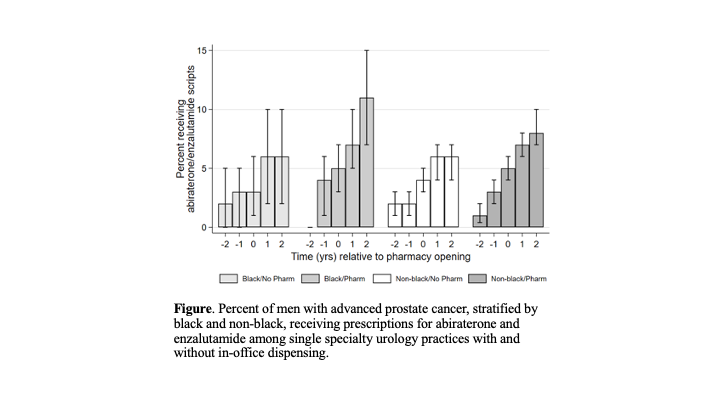
Introduction: Recent advances in the delivery of care for advanced prostate cancer include provision of novel targeted agents directly to patients through in-office dispensing, which has resulted in an increase in the number of prescriptions for abiraterone and enzalutamide. However, the extent to which in-office dispensing may differentially impact black versus non-black men is unknown. Methods: Single specialty urology practices with in-office dispensing initiated between 2014 and 2018 were identified using the National Council for Prescription Drug Programs. Matched control practices without in-office dispensing were also identified. Using a national 20% random sample of fee-for-service Medicare beneficiaries, men with advanced prostate cancer cared for by practices with and without in-office dispensing were identified. The primary outcome of interest was percent of men with advanced prostate cancer receiving prescriptions for abiraterone and enzalutamide over a five-year period (two years before and two years after the year in-office dispensing was initiated), stratified by race (black vs. non-black). Results: A total of 2,444 men in dispensing practices and 1,453 men in practices without dispensing were identified, of whom 15% and 14% were black, respectively. Black men tended be younger, be of lower socioeconomic status, and have similar comorbidity scores compared to non-black patients. The percent of men receiving prescriptions for abiraterone and enzalutamide increased after initiation of in-office dispensing for both black (0% two years before to 11% two years after pharmacy opening) and non-black men (1% to 8%). The increase in prescriptions was less pronounced for practices without in-office dispensing for both black (2% to 6%) and non-black (2% to 6%) men. Conclusions: Following initiation of in-office dispensing among single specialty urology practices, a higher percent of both black and non-black men received targeted agents compared to those cared for by practices without in-office dispensing. SOURCE OF Funding: Avinash Maganty is supported by funding from the National Cancer Institute Ruth L. Kirschstein Postdoctoral Award F32 Grant F32CA275021-01 Brent K. Hollenbeck and Vahakn are supported by funding from a Research Scholar Grant from the American Cancer Society (RSGI-21-097-01-HOPS) and funding from the National Cancer Institute (R01CA269367-01)