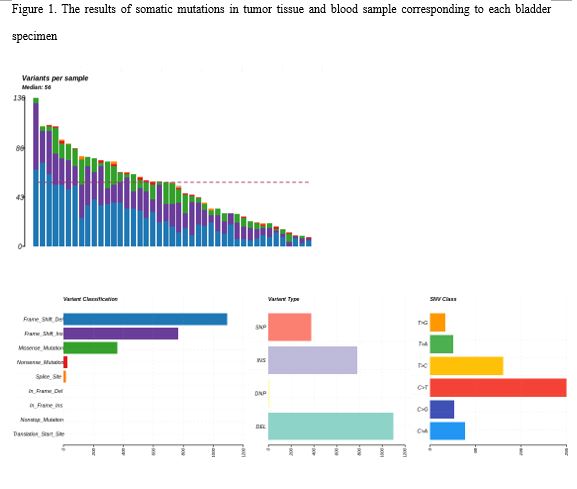
Introduction: The next-generation sequencing (NGS) is widely used in muscle invasive bladder cancer (MIBC), but limited use in non-muscle invasive bladder cancer (NMIBC) due to significant heterogeneity and high cancer-specific survival. Therefore, we aimed to evaluate the genomic information of NMIBC and identify molecular alteration associated with tumor recurrence. Methods: A total of 43 patients with NMIBC who underwent transurethral resection of bladder were enrolled. We performed NGS using oncomine panel on tumor specimen and blood sample corresponding to each specimen. The mutation results were analyzed by pairwise comparison according to the recurrence of bladder tumor within 1 year. Results: The median incidence of genetic variation in 43 tumor samples was 53 variations per sample, and high TMB was associated with tumor recurrence. (median variation 33 vs. 64, p=0.023) The most mutated gene was ATM (79%), followed by NF1 (79%), and NOTCH1 (79%). In the results of pairwise comparison according to the recurrence of bladder tumor within 1-year, epidermal growth factor receptor (EGFR) mutation was significant factor associated with tumor recurrence (odds ratio [OR], 4.81; 95% confidence interval [CI], 1.96-32.92, P=0.045). In addition, TERT (OR, 4.10; 95% CI, 0.92-22.38, P=0.054) and MYCL (OR, 5.22; 95% CI, 0.86-57.88, P=0.068) might be the associated factor of tumor recurrence. Conclusions: Our results revealed that EGFR mutation has a prognostic value on tumor recurrence of NMIBC; therefore, EGFR might be a useful prognostic biomarker in NMIBC. SOURCE OF Funding: None.