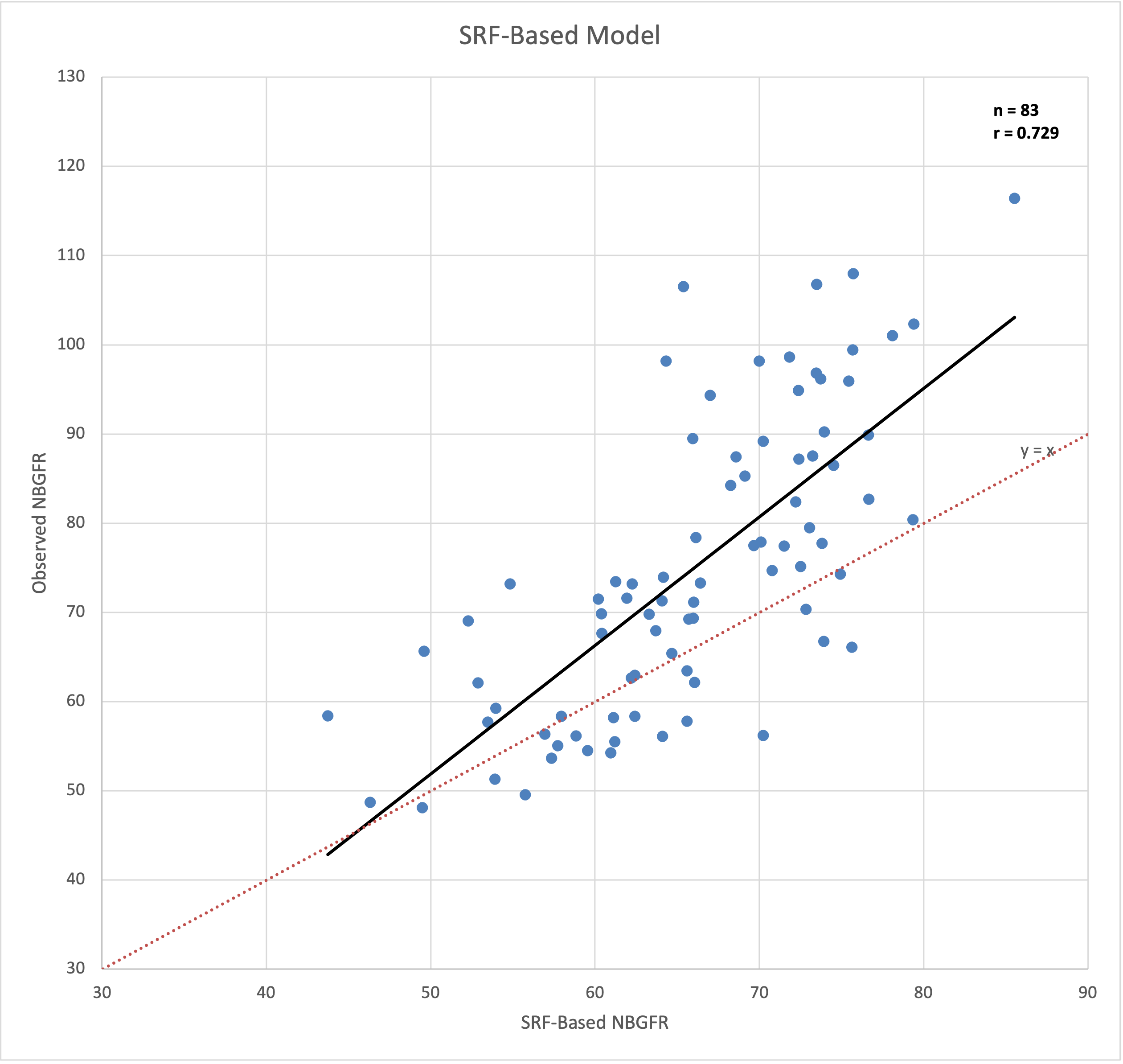
Introduction: Accurate prediction of post donor nephrectomy (DN) glomerular filtration rate is potentially useful for evaluating and counselling of potential living kidney donors. Currently there are limited tools to evaluate the post operative new baseline glomerular filtration rate (NBGFR) in kidney donors. We aim to validate a conceptually simple formula that is based on split renal function (SRF), previously developed for radical nephrectomy (RN) patients (Rathi et al., 2022). Methods: 83 (mean age 46 ± 12, 44.6% males) consecutive patients who underwent DN (years 2010–2016, 16.9% donated right kidney) with preoperative CT imaging and relevant functional data including baseline Global GFR Pre-DN by CKD-EPI (108.2 ± 13.2mL/min/1.73m2) were included. Observed NBGFR was defined as the latest eGFR 3–12 months post-DN as calculated by CKD-EPI. SRF, defined as volume of the contralateral non-resected kidney normalised by total volume of kidneys, was determined using semi-automated software from preoperative cross-sectional imaging (49.2 ± 2.36%). The equation used was: Predicted NBGFR = 1.24 x (Global GFR Pre-DN) x (SRF). Alignment between predicted NBGFR (66.0 ± 8.29mL/min/1.73m2) and observed NBGFR (74.9 ± 16.4mL/min/1.73m2) was assessed by evaluating correlation coefficients, bias, precision, accuracy, concordance and also utilised a Bland-Altman plot to evaluate agreement. Results: The new SRF-based formula for NBGFR prediction correlated strongly with post operative NBGFR (Pearson’s r=0.729, figure 1) and showed minimal bias (median difference = 7.190mL/min/1.73m2) with good accuracy (96.4% within ± 30%, 62.7% within ± 15%) and precision (IQR of bias = -0.094-16.227). The formula tended to underestimate NBGFR values at lower observed NBGFR values and overestimate at higher values. The SRF based formula was also able to accurately discriminate all but one of our patients to a NBGFR of >45ml/min/1.73m2, an NBGFR threshold associated with a reduced risk of renal function deterioration (Campbell et al., 2021). Conclusions: The newly developed SRF-based formula for predicting NBGFR is validated in a living kidney donor population. This gives clinicians an insight into post operative renal function, granting them better ability to prognosticate, educate and pre-empt DN patients. SOURCE OF Funding: There are no sources of funding.

.jpeg.jpg "Nicholas Wong (he/him/his) photo")