MP32-03: Incidence and outcomes of occult lymph node metastasis in clinically cT2-4a No bladder cancer at radical cystectomy with or without neoadjuvant chemotherapy
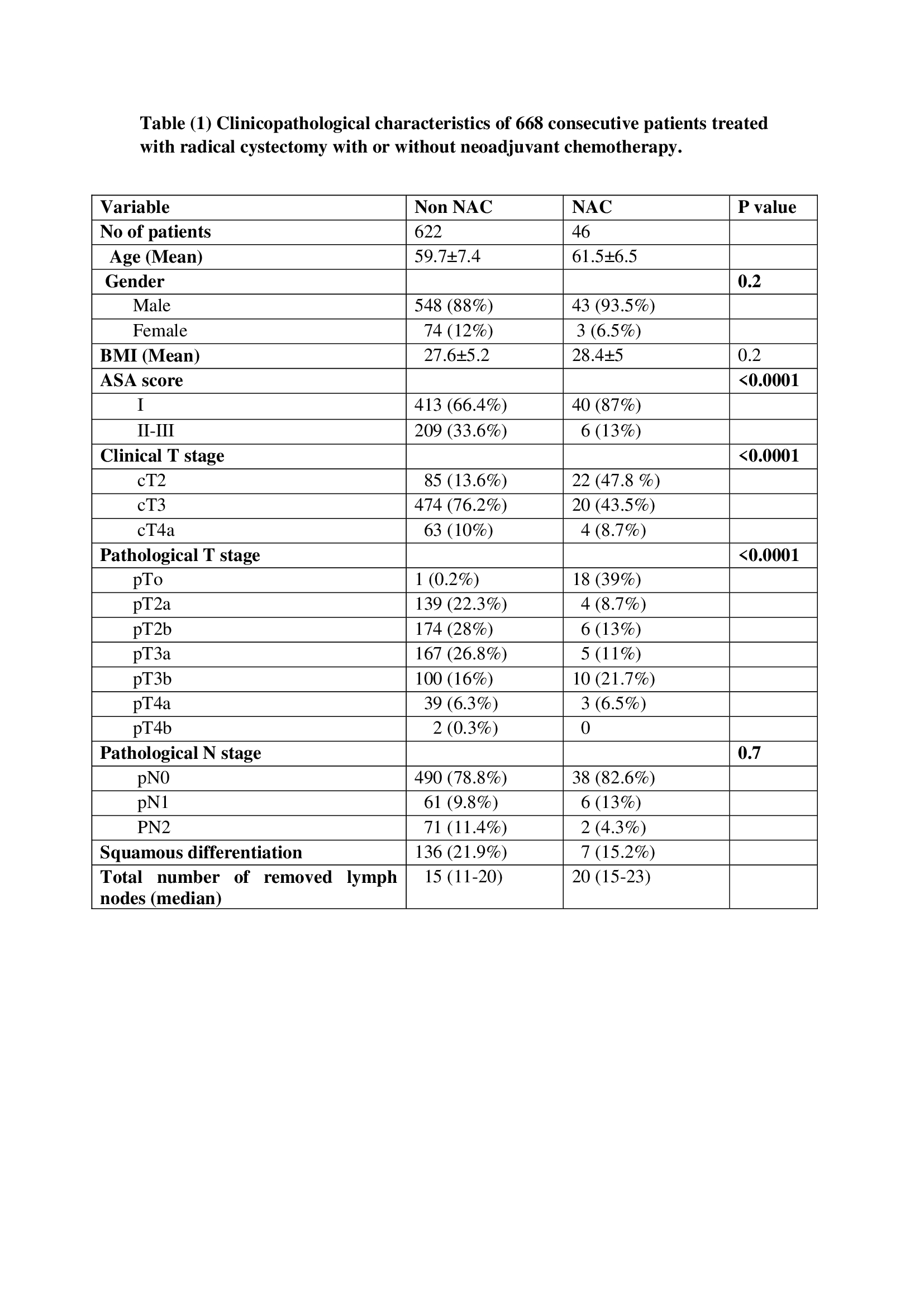
Introduction: Radical cystectomy with pelvic lymphadenectomy is the standard treatment of muscle invasive bladder cancer (BC). However, nearly 50% of patients experience tumor recurrence that can be attributed to presence of occult metastasis at the tie of surgery. One of the goals of neoadjuvant chemotherapy (NAC) is to eliminate micro-metastasis before surgery. We aim to compare nodal metastasis at a large cohort of cNoMo patients treated with cystectomy alone and NAC then cystectomy. Methods: We reviewed the electronic files of 622 consecutive patients diagnosed with cT2-4a NoMo urothelial BC and treated with radical cystectomy between January2004 till December 2014. We also analyzed a recent prospective database of 46 cNoMo patients treated with Cisplatin based NAC then RC between January 2019 till August 2021. The primary end point was the incidence of occult LN metastasis among both groups. The secondary endpoint was to assess recurrence free survival (RFS) in both groups using Kaplan Meier method. Results: Baseline clinical and histopathological characteristics of both groups are shown in Table (1). In the NAC group, 18 patients (39%) had no residual tumor (pTo). Overall, pathological evaluation showed that 140 (21%) of patients had nodal metastasis, eight patients (17.4%) of the NAC group vs 132 (21.2%) of the non-NAC group (P = 0.7). Among the patients with cT2 disease, LN metastases were found in 21.5% (23/107) of cases, five patients in NAC (22.7%) group and 18 (21.2%) patients in non NAC group (p=0.8). Regarding, non NAC group, the estimated 1,3and 5 year RFS between pNO vs pN+ve was 90.2%,74.5 and 70.4% vs 83.7, 42.5% and 40% (p < 0.0001), respectively. Conclusions: Presence of occult lymph node metastasis in cNo bladder cancer is not uncommon reaching 21% of cases. Even in clinically organ confined (cT2No) disease, pathologically confirmed nodal metastasis was found in 21.5% of cases. Occult lymph node metastasis was associated with worse RFS. Inspite of the down staging effect of NAC on the primary bladder tumor, nodal metastasis can still be found in 17.4% of patients. These findings should be considered during counselling patients for NAD or bladder sparing treatment. SOURCE OF Funding: non