MP32-14: Completely dry daytime continence and unmodified sexual function as key aspects of Health-related quality of life after radical cystectomy and orthotopic neobladder
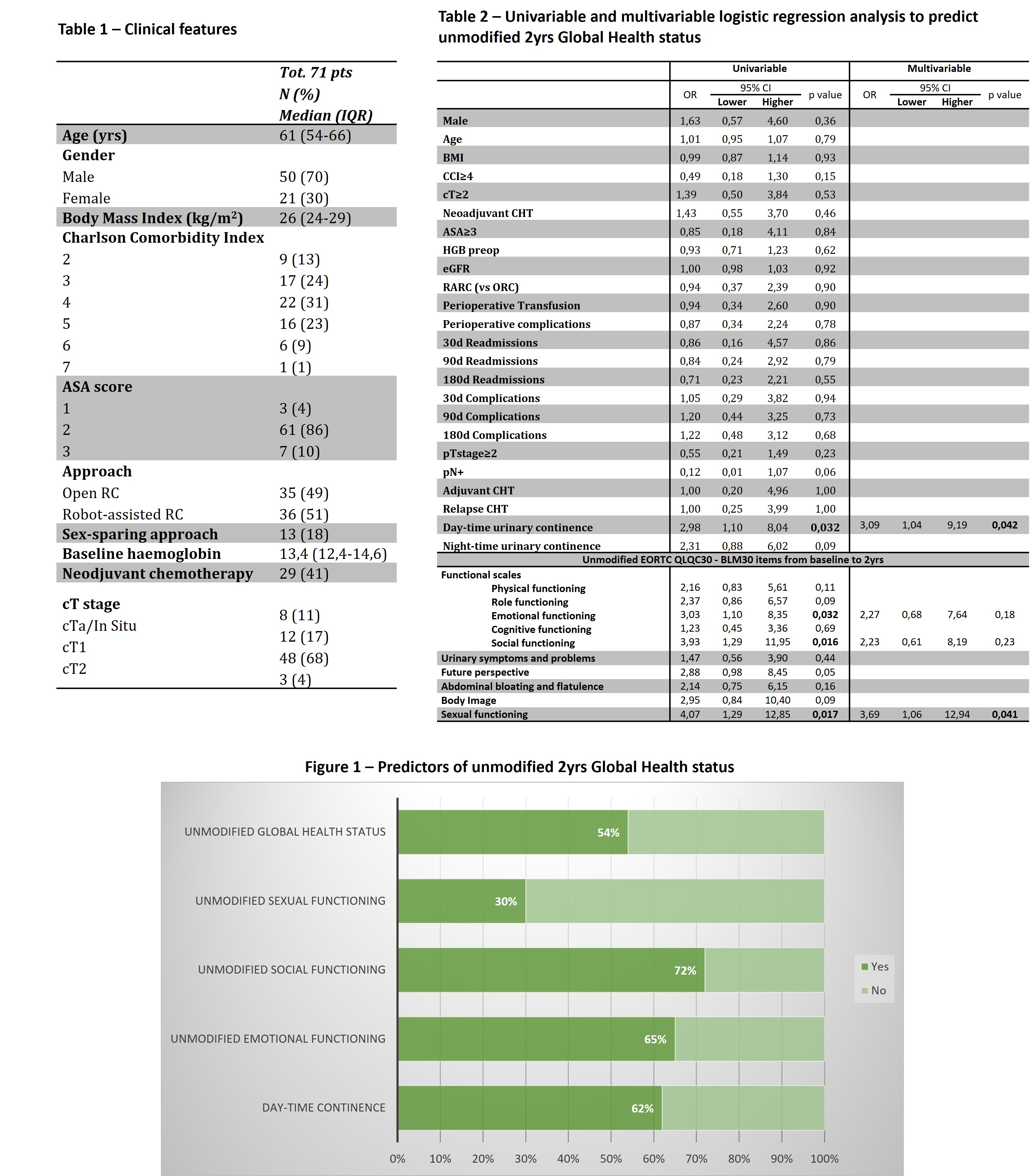
Introduction: Survival outcomes are primary endpoints of oncologic surgery. However, health-related quality of life (HRQoL) is too often misevaluated. Radical cystectomy (RC) with urinary diversion has a significant impact on HRQoL. In this study, we evaluated predictors of unmodified 2yr-QoL after RC with orthotopic neobladder (ON) from an ongoing randomized controlled trial (RCT) comparing ORC and RARC with intracorporeal (i)-UD. Methods: Patients were eligible with a cT2-4cN0cM0, or recurrent HG NMIBC and no anesthesiologic contraindications to robotic surgery. Between Jan 2018 and Sept 2020, 116 patients were enrolled with a covariate adaptive randomization process based on: BMI, ASA score, baseline haemoglobin, UD, neoadiuvant chemo and cT-stage. Data from self-assessed questionnaires (EORTC-QLQ-C30 and QLQ-BLM30), peri- and postoperative data were collected. Unmodified HRQoL was defined as a 2yr Global Health status/QoL increase=0 (?QL=0) from baseline. Continence status was evaluated trough 3-day voiding diaries; day-time continence was defined as “totally dryness” (0gr), night-time continence as pad wetness =50gr. Univariable and multivariable logistic regression (LR) analysis were performed to identify predictors of 2yr ?QL=0. Results: Out of 116 patients enrolled, 88 received ON, and 71 with a minimum 2yr follow-up were included. Two (2) patients were lost to follow-up and 17 patients died within 2yr after surgery. Baseline clinical features were reported (Tab.1). On multivariable LR analysis, day-time urinary continence and unmodified sexual functioning were independent predictors of 2yrs unmodified global health status (Tab. 2). Particularly, 54%, 30%, 72% and 65% of patients experienced unmodified 2 yrs global health status, sexual, social and emotional functioning, respectively; 62% of patients reported a totally dryness day-time urinary continence (Fig. 1). Conclusions: Recovery of completely dry day-time continence status and equal to baseline sexual functioning scores are main drivers of patients' HRQoL 2yrs after RC. These data highlight the need for further assessing oncological safety of sex-sparing techniques and technical improvements to maximize the likelihood of daytime continence recovery in patients receiving RC and ON. SOURCE OF Funding: no