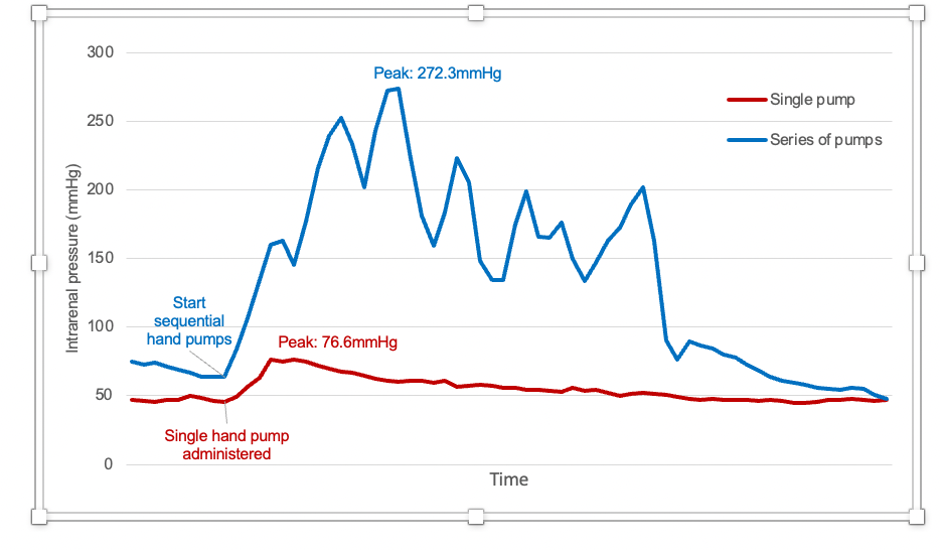
Introduction: Ureteroscopy has become the dominant method of managing urolithiasis. Various methods of irrigation can be utilized to maintain clear views. One such method is the manual pump irrigation, whereby a bolus of fluid is delivered from a chamber in the irrigation system. However raised intrarenal pressures (IRPs) during ureteroscopy consequently ensue, and are of concern due to associated post operative complications. Clinically, this has been correlated with outcomes such as infection, pain, and excessive fluid absorption. We aimed to characterise the increases and maximal IRPs produced by manual pump irrigation used during uretero-renoscopy. Methods: During the uretero-renoscopy procedure a Comet II Pressure Guidewire® (Boston Scientific Corporation, Marlborough, Massachusetts, USA) was used for IRP measurement. Routine flexible uretero-renoscopy for treatment of urolithiasis was undertaken, including manual pump irrigation where this was required to maintain vision. The baseline IRPs, maximal IRPs and the difference between the two were calculated. Results: A total of 17 single manual pump manoeuvres were observed during treatment of this cohort. The median baseline IRP was 36.5mmHg, the median rise in IRP was 29.4mmHg, and the median maximum IRP achieved was 76.0mmHg. A total of 24 serial manual pump manoeuvres were analyzed with the median baseline 39.3mmHg. After the serial hand pump maneuver, the median rise in IRP was 72.3mmHg, with the median maximum IRP achieved being 114.1mmHg. Conclusions: Manual pump irrigation - both single but particularly serial maneuvers - produces significant rises in IRPs and that could logically result in pyelo-venous backflow and sepsis. Our results suggest that this manoeuvre should be avoided, in order to reduce potential complications of flexible uretero-renoscopy. SOURCE OF Funding: None