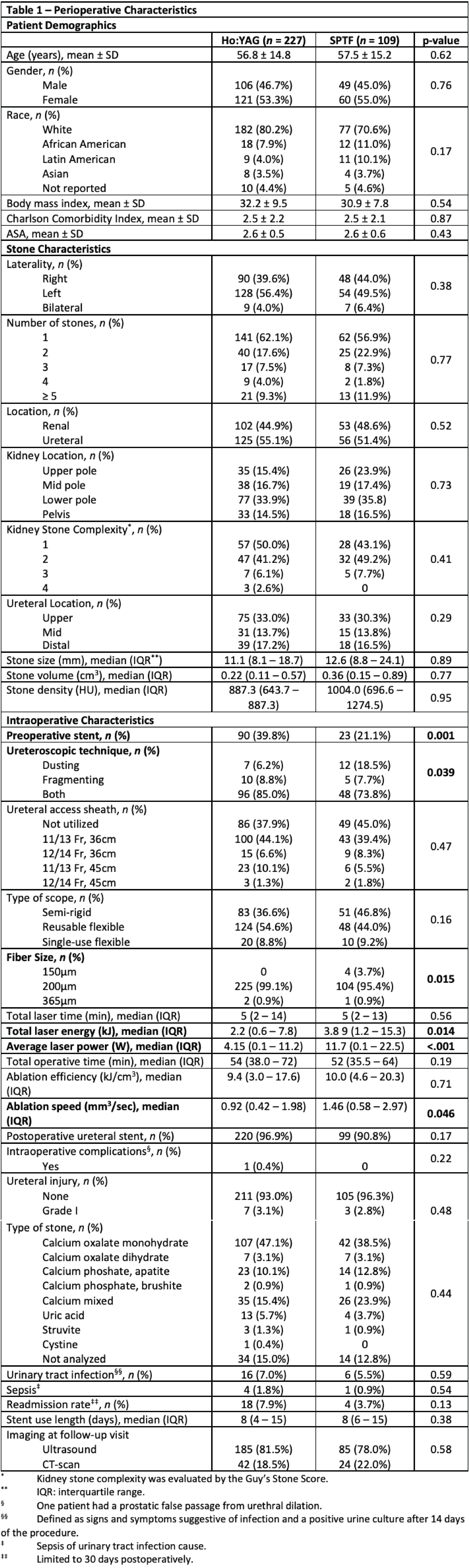
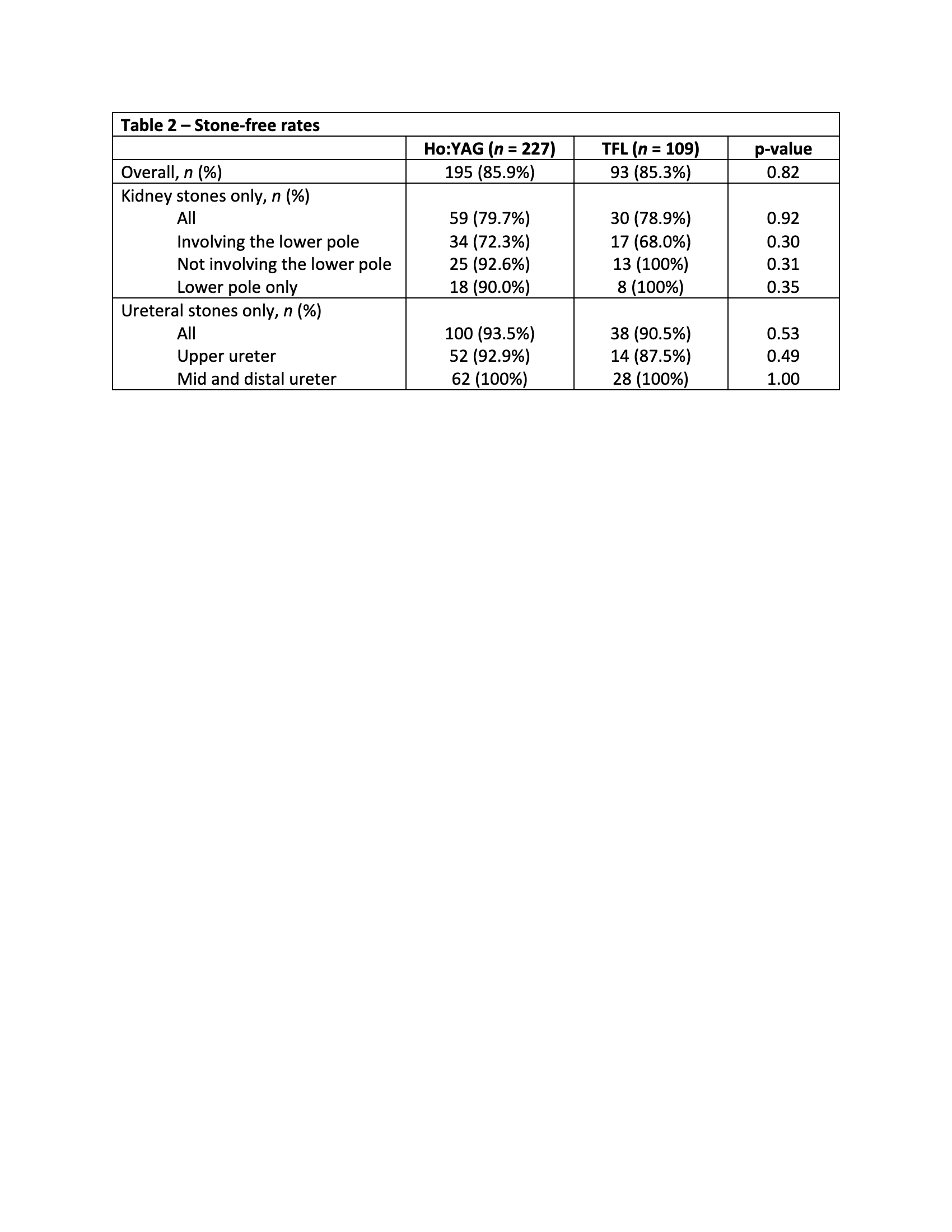
Introduction: Currently, a limited number of studies have compared high-power laser platforms for ureteroscopic lithotripsy (URS-L). We aimed to examine the outcomes of the SuperPulsed Thulium Fiber™ (SPTF) vs. the high-power holmium:YAG (HoYAG) laser for URS-L Methods: We conducted a retrospective chart review from 01/2019-12/2021 of patients undergoing elective URS-L for nephrolithiasis with HoYAG (Lumenis Pulse P120H™, 120W, Boston Sci®) or SPTF (Soltive™, 60W, Olympus®) laser modalities, regardless of stone size, location, or scope type. Exclusion criteria included patients with any urinary diversion, patients who did not undergo follow-up imaging or complete a 12-week post-procedural visit. Stone free status (SFS) was defined as the absence of stone fragments = 2mm on follow up imaging (ultrasound or CT scan). Results: Of the initial 508 patients, 336 met inclusion criteria. Table 1 displays basic characteristics, with no significant difference between HoYAG and SPTF groups. Dusting technique was utilized more often in the SPTF group (18.5% vs. 6.2%, p=.039). Overall, SFS for HoYAG and SPTF were 85.9% vs. 85.3% (OR 1.07, CI 95% 0.56–2.06, p=0.82), respectively. In the stone location subgroup analysis, SFS results were comparable (Table 2). In our model, only BMI (OR 0.94, p=.002) and stone size (OR 0.94, p<.001) were correlated with SFS. When controlling for patients’ BMI, stone size, density, location, and use of ureteral access sheath, we found an adjusted OR 1.01 (CI 95% 0.46–2.23), with no statistical difference between laser modalities (p=0.96). Conclusions: Overall, there is no significant difference in SFS between HoYAG and SPTF groups, along with similar ablation efficiency and complication rates. Although ablation speed was significantly higher in the SPTF, total operative time was comparable. SOURCE OF Funding: None.