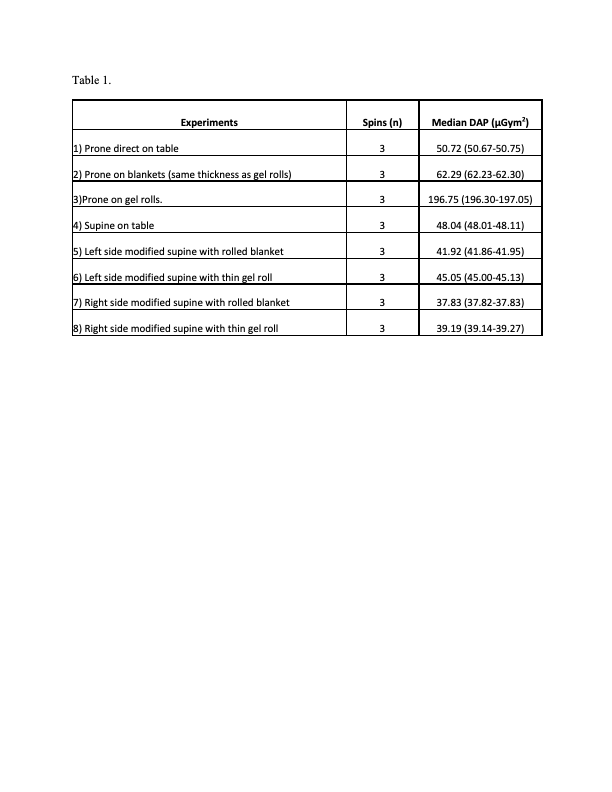
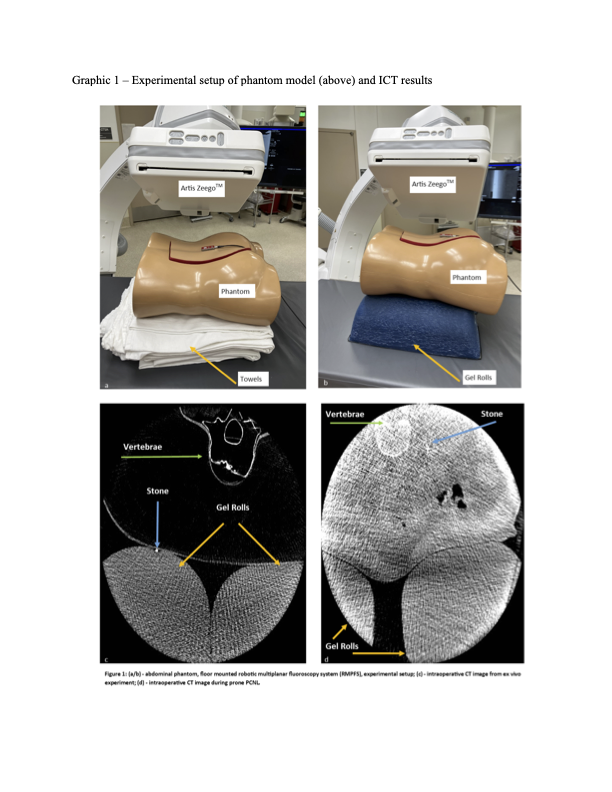
Introduction: Prone percutaneous nephrolithotomy (PCNL) has been associated with higher fluoroscopy doses than supine PCNL. As part of a QI project, the authors now routinely use an Artis Zeego Care+Clear™ (Siemens) floor-mounted robotic multiplanar fluoroscopy system (RMPFS) to perform ultra-low-dose (ULD) intraoperative CT scans (ICT) during treatment of large stones. Despite lower BMI (27.6 vs. 30.0) and the same protocol (5s BODY CARE), the ULD ICT dose area product (DAP) for the single prone PCNL case was 84% higher (1036 vs. 564 uGy*m2) than when performed supine (n=26). Because gel rolls were visible in coaxial imaging, we hypothesized that gel rolls directly increased radiation exposure. Methods: Ex vivo experiments were performed with RMPFS 5s BODY protocol coaxial imaging using a prone-positioned fluoroscopy phantom placed on a gel roll; placed on blankets of equal thickness; or directly on the table. Spins were also performed in the supine and modified supine positions; using a thin gel roll or rolled blanket. Reported DAP was compared for the groups. Results: Mean DAP was 3.9 times higher when the phantom was prone on gel rolls than directly on the table; and 3.2 times higher than prone on blankets. Thus, total radiation dose increased by 287% when gel rolls were used for positioning. With blankets, the total radiation dose was 23% higher in the prone position. There was a modest 5.6% increase in DAP between prone and supine positioning. In the modified supine position the use of a thin gel roll increased the total radiation dose 3–8 % compared to blankets. Conclusions: Our hypothesis was confirmed experimentally with a standardized protocol that gel rolls directly increase measured radiation dose. Surgeons should consider radiolucent materials for positioning to limit radiation exposure to patients and the surgical team. Following this observation, the authors have substituted rolled blankets for gel rolls for PCNL positioning. SOURCE OF Funding: None