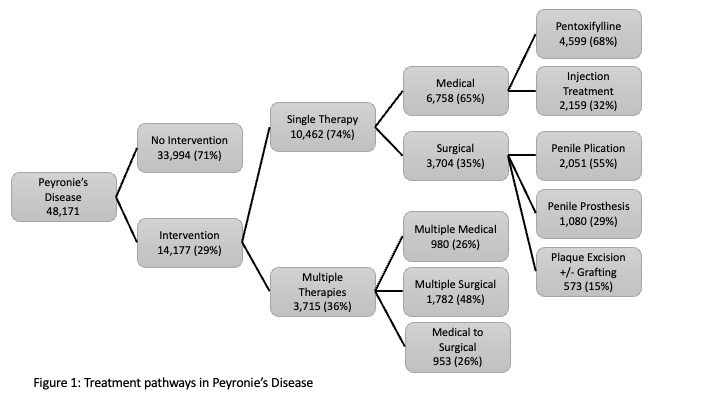
Introduction: Peyronie’s disease (PD) is a fibrosing condition which commonly leads to penile pain, curvature, plaque development, change in penile shape, sexual dysfunction, and psychological bother. Our objective was to identify the patterns in the treatment choice for PD, specifically focusing on observation, pentoxifylline, injection therapy, penile plication, plaque excision with/without grafting (PEG), and penile prosthesis. Methods: We queried the TriNetX database for adult men with Peyronie’s disease (ICD-10, N48.6) and interventions pertaining to this from 2002-2022. Interventions were identified by CPT codes and included injection therapy (54200), penile plication (54360), plaque excision +/- grafting (PEG) (54110, 54111, 54112), and penile implant (54400, 54401, 54405). Use of oral pentoxifylline (8013) was identifiable using RxNorm Concept Unique Identifier. We also evaluated the demographics of the different treatment groups using ICD-10 codes, including patient age, race, ethnicity, diabetes (DM), hyperlipidemia (HLD), coronary artery disease (CAD), peripheral vascular disease (PVD), hypertension (HTN), smoking history, connective tissue disorder, and history of pelvic trauma. Results: Overall, there were 48,171 cases of PD identified. The most common management was observation in 71% of cases (n=33,994). A single medical or surgical therapy was used in 74% of patients who received treatment (n=10,462). Of single medical therapy cases, pentoxifylline (68%, n=4,599) was the most used medical treatment followed by injection therapy (32%, n=2,159). Penile plication was the most frequently utilized surgical therapy (55%, n=2,051) followed by penile prosthesis (29%, n=1,080) and PEG (15%, n=573). Patients underwent multiple therapies 36% of the time (n=3,715). Of patients requiring multiple therapies, a progression of medical to surgical treatment only occurred in 26% (n=953). Conclusions: PD was predominantly managed without any intervention, followed by medical therapy, and then surgery. Surgical therapy occurred less frequently after medical treatment suggesting that few patients are interested in a stepwise approach from medical to surgical treatments for PD. SOURCE OF Funding: None