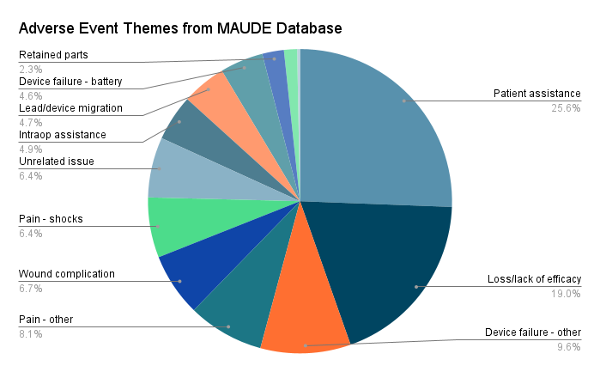
Introduction: Over 350,000 sacral neuromodulation (SNM) devices have been implanted since approval by the FDA in 1998 (Medtronic, 2022). SNM technology and clinical applications have evolved, with minimal safety updates after initial trials. Here, we provide an updated on real-world SNM safety. These insights will guide informed consent, preoperative counseling, and patient expectation-setting. Methods: The FDA Manufacturer and User Facility Device Experience (MAUDE) database is a repository for medical device safety reports. We performed MAUDE categorical (1/1/98-12/31/10) and keyword (1/1/11-9/30/21) searches for “Interstim”. A random sample of 1,000 reports was reviewed and categorized by theme. To corroborate this analysis, a legal librarian searched the Public Access to Court Electronic Records database, as well as Bloomberg Law’s dockets database for all lawsuits related to SNM devices. Results: Our search of the MAUDE database returned 44,122 SNM-related AEs. Figure 1 illustrates the prevalence of event categories in the random sample. The largest proportion of reports (25.6%) related to a patient’s need for assistance with device use followed by loss/change of efficacy (19.0%). Interestingly, a fall preceded issue onset in 32% of non-shock pain, 30% of lead/device migration, and 27% of painful shock reports. Our legal search revealed only 4 lawsuits: patient complications after off-label SNM device use, transverse myelitis after implant, device migration or poor placement, and a claim of device malfunction requiring removal and causing permanent injury. Conclusions: This review confirms the real-world safety and very low complication rates of SNM devices, as seen in clinical trials. We found that 43.3% of SNM “complications” are not AEs, but rather reflect a need for improved technical support or more comprehensive informed consent to convey known device limitations to the patient. Similarly, the number of lawsuits is shockingly low for a device that has been on the market for 24 years, reinforcing the safety of the device. Legal cases involving SNM devices seem to relate to inappropriate patient selection—including at least one case in which SNM was used for a non-FDA approved indication—lack of appropriate follow-up, and/or provider inability to assist the patient with utilizing the device after implantation. SOURCE OF Funding: None.