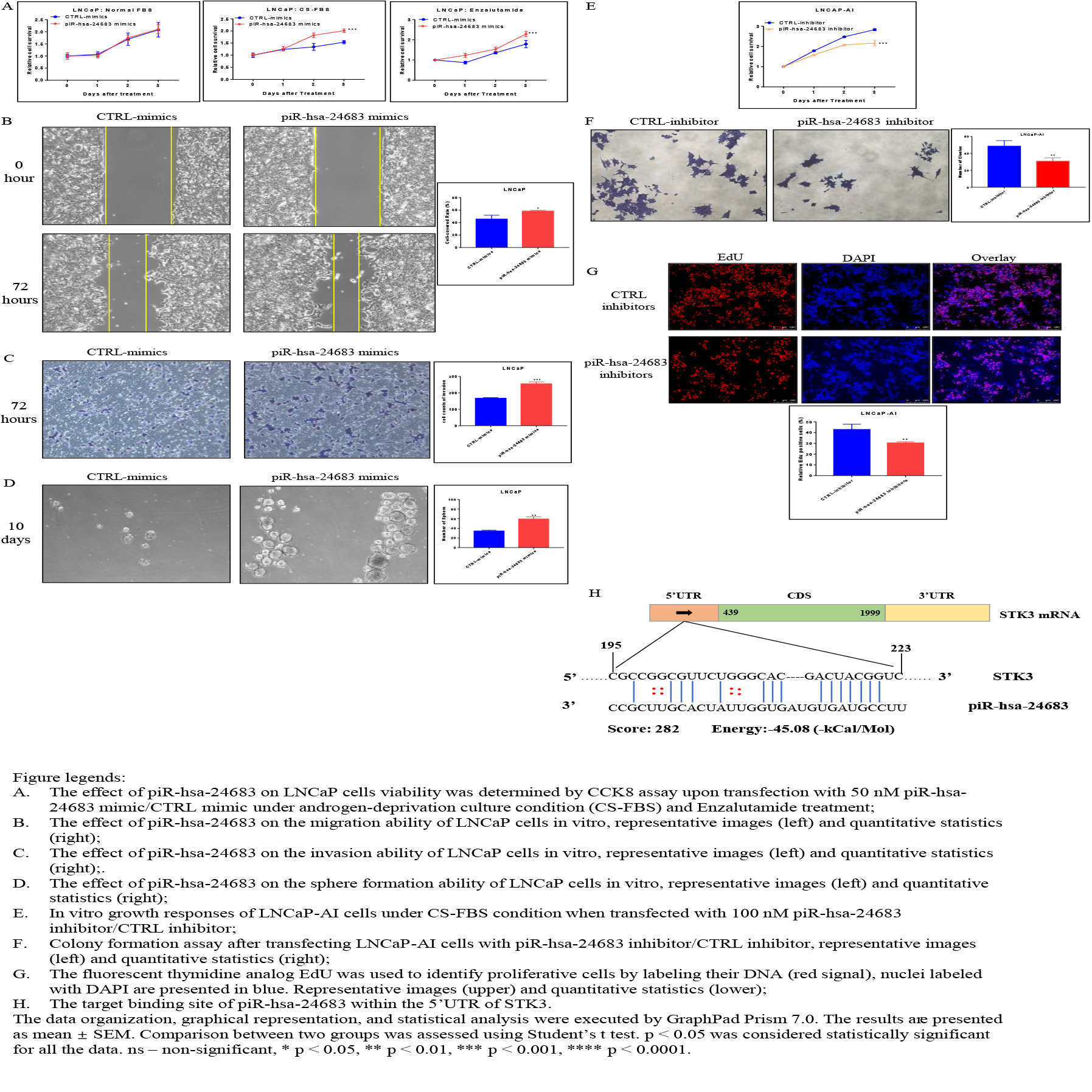
Introduction: PIWI-interacting RNAs (piRNAs) are a class of small non-coding RNAs (sncRNAs) mechanistically similar to but much less studied than microRNAs. piRNAs represent the most diversified sncRNAs that are widely involved in the pathogenesis of different types of cancers including prostate cancer (PCa). Our study aimed to investigate the role of piRNAs in the development of castration-resistant prostate cancer (CRPC). Methods: Small RNA sequencing was used to explore the CRPC associated piRNAs on a basis of 10 benign prostate tissues, 10 paired hormone-sensitive PCa tissues and CRPC tissues from the same patients. The top 8 upregulated piRNAs were validated through qRT-PCR in a bigger cohort. piR-hsa-24683 was selected and investigated its biological function by gain of function in vitro. To study its loss of function role, an androgen-independent PCa cell (LNCaP-AI) was established. For mechanistic investigation, the mRNA sequencing analysis of differentially expressed genes (DEGs) was conducted in PCa cells transfected with control/piR-hsa-24683 mimics. Then, potential downstream targets were further predicted by miRanda program and validated by qRT-PCR. Results: piR-hsa-24683 demonstrated a relatively higher expression level in both CRPC tissues and CRPC cell lines when compared with PCa tissues and cells. Functionally, overexpression of piR-hsa-24683 could confer resistance to androgen deprivation and anti-androgen in PCa cells in vitro, whereas anti-sense RNA against the piR-hsa-24683 could potentiate the sensitivity to androgen deprivation in LNCaP-AI cell. In addition, piR-hsa-24683 showed the ability in promoting sphere formation, migration and invasion of PCa cells. Mechanistically, mRNA sequencing results identified a panel of downstream target-genes. Among them, serine/threonine kinase 3 (STK3) was predicted to have a direct binding relationship with piR-hsa-24683, and was successfully verified to be negatively regulated by piR-hsa-24683. Conclusions: Our study showed, for the first time, that piR-hsa-24683 can contribute to androgen insensitivity in CRPC. This sheds a new insight into the regulation of CRPC by a sncRNA piRNA, which may form the basis of a novel target in the treatment of CRPC. SOURCE OF Funding: UGC Research Matching Fund 8601404