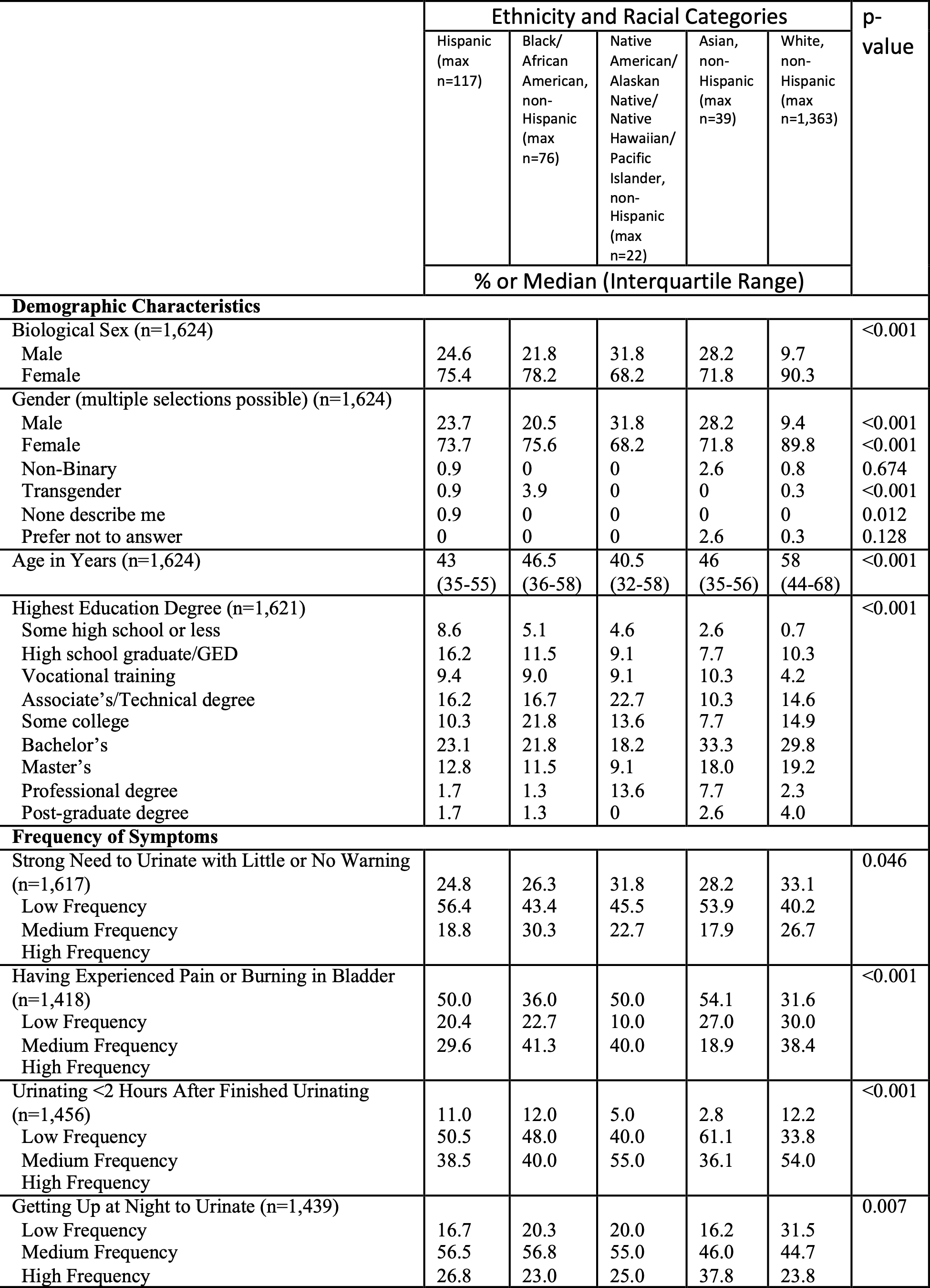
Introduction: Interstitial cystitis/bladder pain syndrome (IC/BPS) is a multifactorial, chronic syndrome involving urinary frequency, urinary urgency, and bladder discomfort that affects an estimated 10 million patients in the United States. Diagnosing IC/BPS focuses on the exclusion of other diseases and patients report that receiving a diagnosis involves multiple healthcare providers and usually takes several years. Therefore, this study focused on the comparing the experiences and diagnostic journeys between different races and ethnicities. Methods: In collaboration with the Interstitial Cystitis Association and Inspire.com, we administered a web survey around IC/BPS symptomatology and pain experiences between June and August 2022. Ethnicity and racial identities were categorized into 5 groups: Hispanic (1), and the non-Hispanic groups Black/African American (B/AA) (2), Native American and Hawaiian (NAH) (3), Asian (4), and White/Caucasian (W/C) (5). We used Chi2-test to compare categorical variables and median tests to compare continuous variables across the 5 race/ethnicity groups. Results: Overall, 1,631 respondents answered the survey (Table 1). B/AA and W/C perceive the strong need to urinate with little warning as well as having bladder pain to occur at a higher frequency compared to Hispanics (p=0.046; p<0.001). Urinating <2 hours after having urinated is reported to occur at a higher frequency in W/C and NAH (p < 0.001). Hispanics are less likely to report bladder pain to be a big problem (p=0.001). Getting up at night to urinate is a big problem for B/AA (p=0.037). B/AA had the shortest median time (0.5 years) between start of symptoms and diagnosis while W/C had the longest (2 years) (p < 0.001). Conclusions: Our survey of individuals with IC/BPS found differences in experiences between races and Hispanic ethnicity, including the impact of pain and time to diagnosis. However, only 16% of individuals responding were Minorities (vs. 58% of the US population) and 5% of individuals responding were AA (vs. 13% of the US population). This indicates that additional investigation is warranted to understand the experiences and needs of Minority individuals with IC/BPS. SOURCE OF Funding: U54DK104309-08