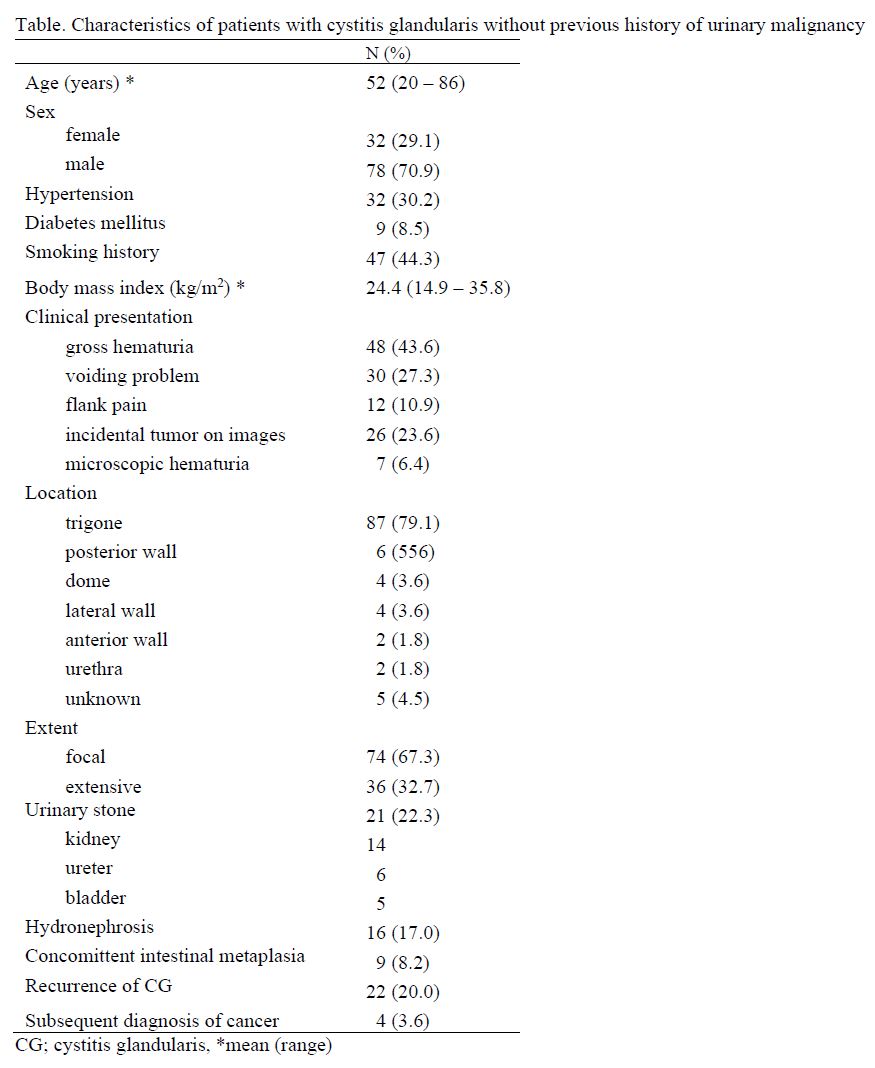
Introduction: Although cystitis glandularis (CG) is no longer considered as a premalignant condition, its clinical significance is still unclear. We aimed to understand clinical significance of CG in large contemporary series. Methods: We retrospectively reviewed a total of 169 patients diagnosed with CG in two tertiary hospitals from 2005 to 2021. Fifty-nine patients with previous or concurrent history of urinary tract malignancy were excluded. Medical records including demographics, endoscopic and imaging studies, and their management were reviewed. Finally, 110 patients were enrolled in the analysis, and their mean follow-up was 3.3 years. Results: The mean age was 52.0 years, and the male / female ratio was 2.4:1. Presenting symptoms were gross hematuria, voiding problems and flank pain in 43.6%, 27.3% and 10.9%, respectively, and the others were asymptomatic. In cystoscopic findings, trigonal area (n = 87, 79.1%) was the most common site of CG. Thirty-six patients (32.7%) showed extensive lesions, including the bladder neck circumferentially, and the others revealed focal lesions. Patients with extensive lesions were predominantly male (97.2%) and relatively younger than those with focal lesions (40.4 years vs. 57.1 years). Imaging studies revealed urinary stones in 21 patients (22.3%) and hydronephrosis in 16 patients (17.0%). Hydronephrosis was caused by the same CGin 6 patients (6.4%) and by other causes such as urinary stones and ureteral strictures in 10 patients. CG-induced hydronephrosis was successfully managed by transurethral resection in 4 patients, but renal function was deteriorated with aggravated hydronephrosis in 1 patient and ureteroneocystostomy was performed in 1 patient. Subsequent urinary malignancy was developed in 4 patients, all of their histology was urothelial carcinoma, which was diagnosed 6, 12, 17, and 36 months later. No adenocarcinoma was found. Conclusions: This large contemporary series also argues that CG is not a premalignant lesion for adenocarcinoma. However, subsequent urothelial carcinoma was found in some patients, which may be missed on initial examination or occur later. This suggests that thorough initial work-up and careful follow-up are mandatory for CG despite its benign nature. SOURCE OF Funding: None