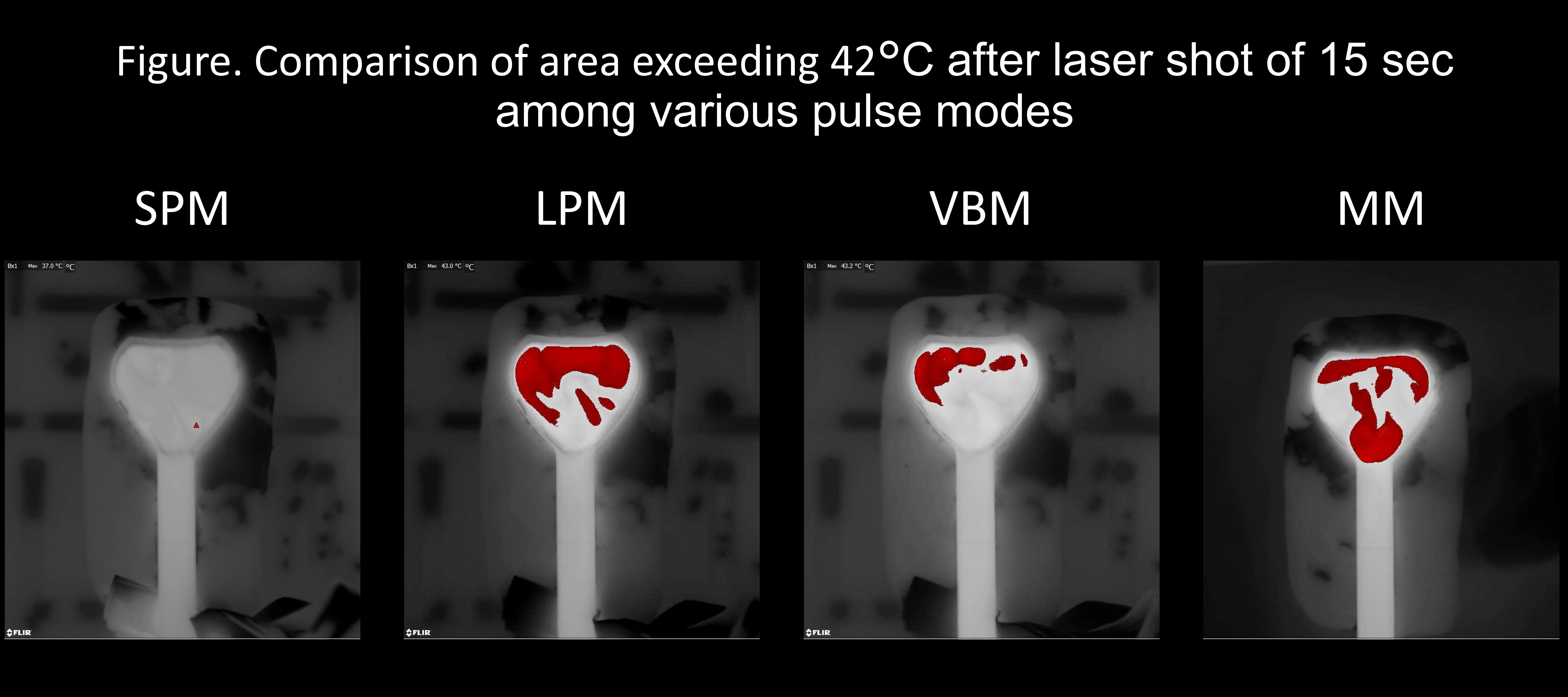
Introduction: Moses Mode and Virtual Basket Mode are special pulse modulation modes based on Moses technology. However, no previous study has directly compared irrigation temperatures between these two modes. The aim of this in-vitro phantom study was to evaluate the dynamic changes of irrigation temperatures and compare those between these two modes by using thermography. Methods: We created an unroofed pyelocaliceal model by using silicon flask of 50mm and filled it with 37 °C saline. A flexible ureteroscope (LithoVue) with 200 µm laser fiber was placed in an 11/13 Fr ureteral access sheath inserted into this model. The distance between saline surface and the tip of laser fiber was 5mm. The laser fired for 60 sec at 0.4J/60Hz. Three runs were tested per setting used short pulse mode (SPM), long pulse mode (LPM), Virtual Basket Mode (VBM) (by using 100W CyberHo, Quanta) and Moses Contact Mode (MM) (by using Pulse 120H, Lumenis). Dynamic changes of irrigation temperatures with and without saline irrigation (25mL/min) were evaluated by using thermography. We compared the time until 42°C was achieved, the highest reachable temperatures and the area exceeding 42°C among those modes. Results: The time until 42°C was achieved in SPM, LPM, VBM and MM was 19.3sec, 6.7sec, 14.3sec and 9.0sec, respectively. The time in MM was significantly shorter than that in VBM (p=0.03). On the other hand, the highest reachable temperatures in these modes were respectively 47.4°C, 49.6°C,48.4°C and 48.6°C, and there was no significant difference of temperatures between VBM and MM (p=0.86). Although there was no significant difference of the area exceeding 42°C after laser shot of 15sec between VBM and MM (17.4% vs 35.5%, p=0.10), the position and spread of high temperature region differed depending on laser modes (Figure). While the area with high temperature spread to the going straight direction of laser in VBM, the area spread also around the ureteroscope as well as the straight direction of laser in MM. Conclusions: The speed of irrigation temperature rise in MM was faster than that in VBM. Thermography-based evaluation of irrigation temperatures suggested that the irrigation fluid might flow faster in MM than in VBM. SOURCE OF Funding: None.