MP07-01: Mesh-Free Management of Apical Pelvic Organ Prolapse: A Comparative Study of Vaginal Sacrospinous Fixation v Robotic Uterosacral Ligament Suspension.
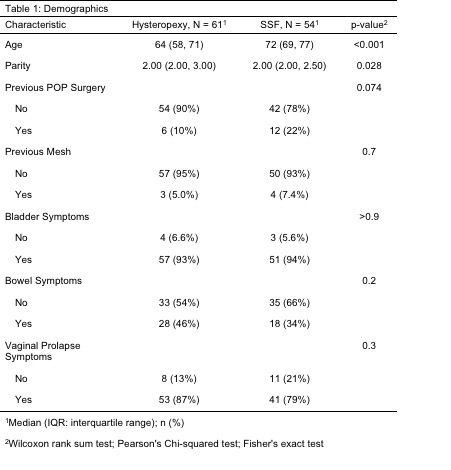
Introduction: Pelvic organ prolapse (POP) significantly impacts quality of life for many women. Mesh sacral colpopexy (SCP) has a recurrence rate up to 23%, and vaginal procedures to correct apical POP up to 41%. After the FDA warnings and restrictions of transvaginal mesh, increasing concerns regarding mesh have resulted in a need for mesh-free alternatives. This study compares 2 mesh-free techniques, robotic/laparoscopic uterosacral ligament suspension (RUSL) and vaginal sacrospinous fixation (SSF) in managing apical POP. Methods: A prospective clinical audit of 115 women with apical POP who underwent RUSL (n=61) or SSF (n=54) by a single surgeon. Demographic data included age, parity, and previous POP surgery. A pre-operative (preop) pelvic floor (PF) questionnaire was used to identify prevalence of bladder, bowel and vaginal symptoms. POP-Q was recorded at surgery and at post-operative (postop) reviews. The absolute change in POP-Q scores were recorded as objective measures of PF support. Other postop metrics used include symptomatic vaginal bulge, need for repeat POP surgery (reop) and subjective improvement in symptoms based on patient-reported outcome measures (PROMs). Postop adverse events (AE) were recorded (Clavien Dindo grading scale). Wilcoxon rank sum test, Pearson’s Chi-squared test and Fisher’s exact test were used to compare groups, and univariate analysis to predict factors for success/reop. Results: Baseline demographics were similar (Table 1). Mean time from surgery was 736 (RUSL) and 565 days (SSF). Difference in postop C points was not significant (RUSL: median -8 (IQR 2), SSF: median -7cm (IQR 2), P=0.279). Procedure success rates (postop C point <0) were not different (RUSL 90.2%, SSF 92.5%, P=0.92). Reop rates for apical recurrence were SSF 1.9%, RUSL 6.6%, P=0.21; univariate odds ratio 0.26 [95% CI 0.03 to 2.43]. Univariate analysis for reop found that age, parity and surgery type were not predictors of reoperation (P=0.26, P=0.92, P=0.78). The most common postop AE was urinary tract infection (RUSL 10.2%, SSF 10.5%). Conclusions: RUSL and SSF are safe and effective mesh-free techniques for management of apical POP based on objective improvements in POP-Q score and PROMs. SOURCE OF Funding: None