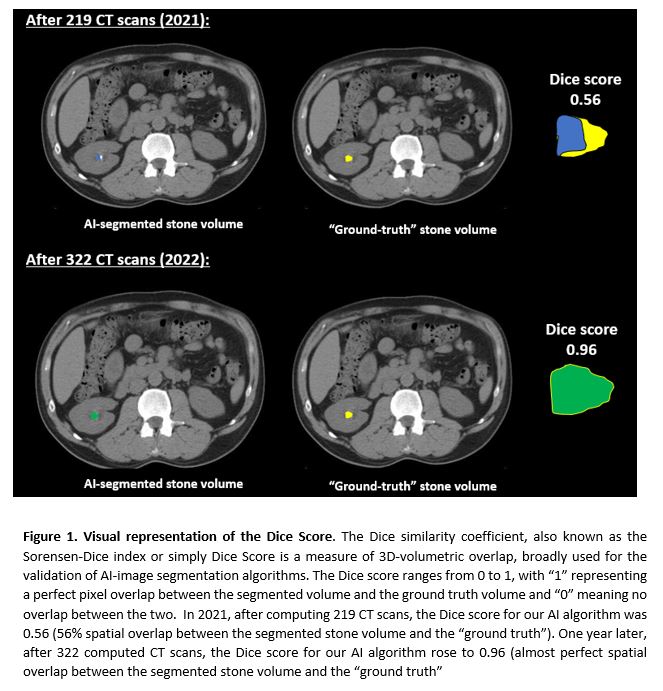
Introduction: Given the irregular shape of most renal stones, linear measurements as well as the use of the ellipsoid formula have proven inaccurate in depicting stone volume. In contrast, CT-based, 3D-stone volume measurement have proven to be a far more accurate determination of stone volume; however, using a 3D slicer program to derive CT-based stone volume is both time intensive and subject to human error. Accordingly, we sought to train a deep learning convolutional neural network (CNN) to automate kidney segmentation and CT-based stone volume calculation. Methods: A total of 322 CT exams in patients with renal stones were used in this study. A total of 80% of the data was used for algorithm training while the remaining 20% of the data used for algorithm validation. “Ground truth” for actual stone volume, was determined by manual segmentation of the stones on the 322 CT scans using the 3D Slicer software program. Using an initial seed point manually identified for each stone, a 16 layer fully convolutional contracting-expanding neural network spanning 473,410 parameters, was designed to detect and segment renal calculi. To assess the accuracy of the CNN in identifying and calculating the stone volume, both a Pearson correlation coefficient and a Dice Score were calculated (Figure 1). Statistical analysis was aggregated following a five-fold cross-validation. Results: The CNN algorithm calculated stone volumes had a Dice score of 0.967 and a Pearson correlation coefficient (R) of 0.999 compared to the ground truth volumes. Conclusions: A deep learning CNN developed at our institution was able to automatically segment renal stones providing an accurate, efficient, and consistent tool for determining stone volume. SOURCE OF Funding: None.