Medical Student Case Western Reserve University School of Medicine
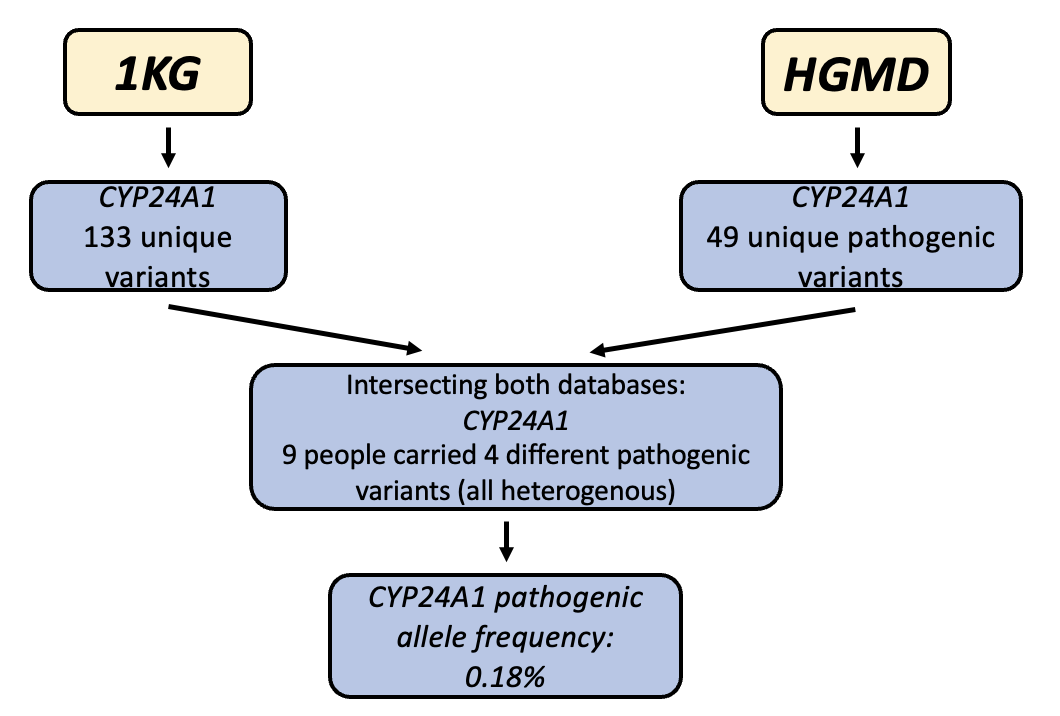
Introduction: Vitamin D is used to treat rickets, and has been proposed to reduce risk of osteoporosis, fractures, multiple sclerosis, and other conditions. However, it is contraindicated in people with infantile idiopathic hypercalcemia (IIH). IIH is a rare autosomal recessive disorder caused by impaired 24-hydroxylase enzyme activity encoded by the CYP24A1 gene; patients present with hypercalcemia from increased calcium absorption, increased osteoclast activity, and decreased calcium excretion, and vitamin D supplementation causes nephrolithiasis and nephrocalcinosis. The clinical prevalence of IIH is unknown.This study seeks to characterize the prevalence of IIH caused by frequencies of pathogenic variants in CYP24A1, which can improve screening and prevent complications from inappropriate vitamin D supplementation. Methods: Known pathogenic variants of CYP24A1 causing IIH were generated from the Human Gene Mutation Database (HGMD). The 1000 Genomes (1KG) database was used to identify healthy individuals with CYP24A1 variants. HGMD and 1KG databases were intersected to find shared variants, and prevalence was calculated using the Hardy-Weinberg equation. Results: After intersecting the HGMD database with the 1KG database, four disease-causing variants were identified in 9 individuals, all heterozygotes. This yields a carrier rate of 1 in 278 and an affected rate of 1 in 308,641. Conclusions: We estimate one in 308,641 is contraindicated with vitamin D supplement which will cause nephrolithiasis and nephrocalcinosis. Previous genetic analyses have characterized the prevalence of IIH using dbSNP which include both pathogenic and benign variants. We used HGMD to limit the variants that are disease-causing, and used 1KG to assess the frequencies in the general population. Further studies are needed to identify other contributing factors towards IIH, but this study provides an estimate of the clinical prevalence of IIH to identify patients for whom vitamin D supplementation is contraindicated. SOURCE OF Funding: None to disclose.