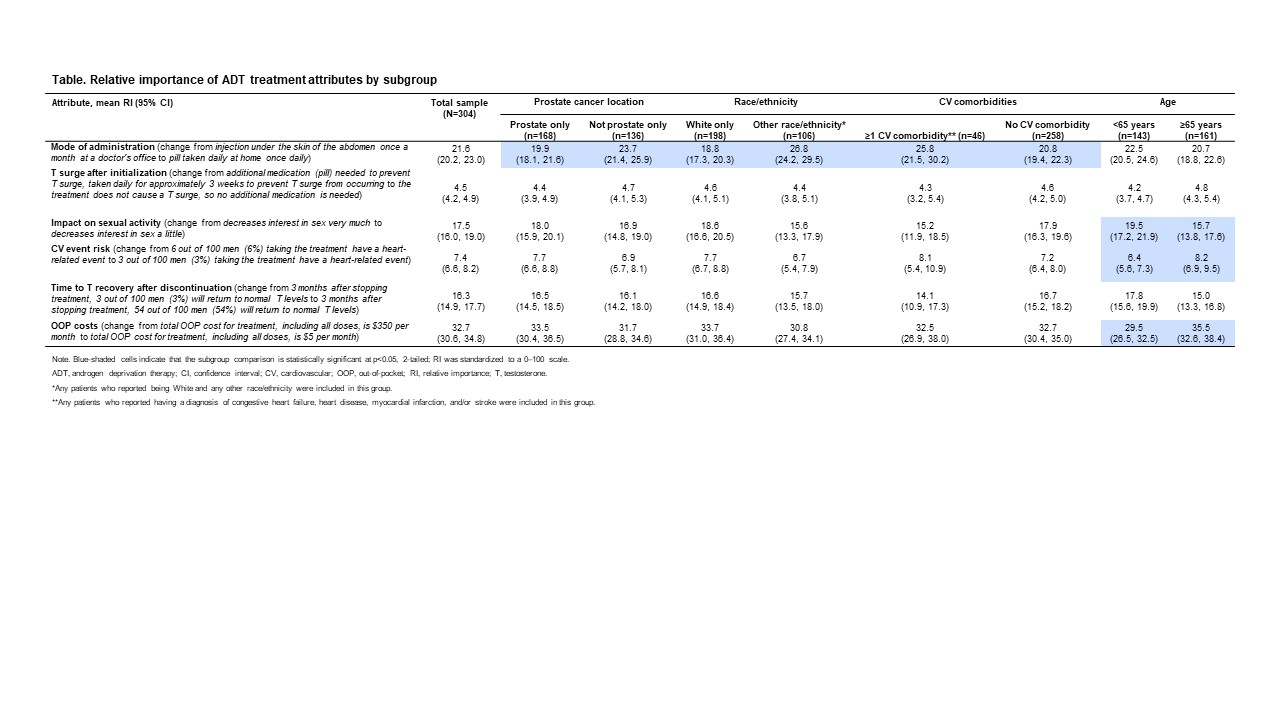
Introduction: Androgen deprivation therapies (ADTs) have evolved to include several options varying in administration, adverse event profiles, speed of testosterone (T) recovery and onset, and costs. This study assessed preferences for key attributes of ADTs for prostate cancer (PC). Methods: US men aged >40 years who self-reported a PC diagnosis and had healthcare coverage for the past 3 years were recruited via healthcare research panels to complete a cross-sectional survey. Men who did not know/recall whether ADT was received or who were unable to complete the survey independently were ineligible. A discrete choice experiment assessed ADT attribute preferences. Hierarchical Bayes models estimated attribute level preference weights; relative importance (RI) was computed using the difference between preference weights of most and least favorable levels of each attribute standardized to 0–100 scale. RI was compared by subgroup (ADT experience, age, race/ethnicity, PC location, and cardiovascular [CV] comorbidities) with 2-sample t-tests. Results: Of 304 men with PC (65.1% White), mean age was 64.4 years. Mean time from diagnosis was 5.4 years; 55.3% reported organ-confined PC and 49.0% had prior ADT use. Reducing out-of-pocket (OOP) costs from $350 to $5 per month (RI=32.7) and change from once-monthly injection to daily pill (RI=21.6) were more important than each of the other attributes (Table). Improvements in impact on sexual activity (RI=17.5) and time to T recovery after discontinuation (RI=16.3) were 2- to 4-fold as important as reduced CV event risk (RI=7.4) and T surge after initialization (RI=4.5). Change from once-monthly injection to daily pill was more important to non-White men, men with CV conditions, and those whose PC had spread (p < 0.05). Preferences for improvements in impact on sexual activity and time to T recovery after discontinuation, and reduced OOP cost differed between age groups (p < 0.05). RI did not vary between ADT-experienced and ADT-naïve men. Conclusions: When selecting ADT, OOP cost had the most impact, overall and across subgroups. Given the variations in salience of ADT attributes, especially mode of administration, shared-decision making should take individuals’ preferences into account. SOURCE OF Funding: The study was funded by Myovant GmbH in collaboration with Pfizer.