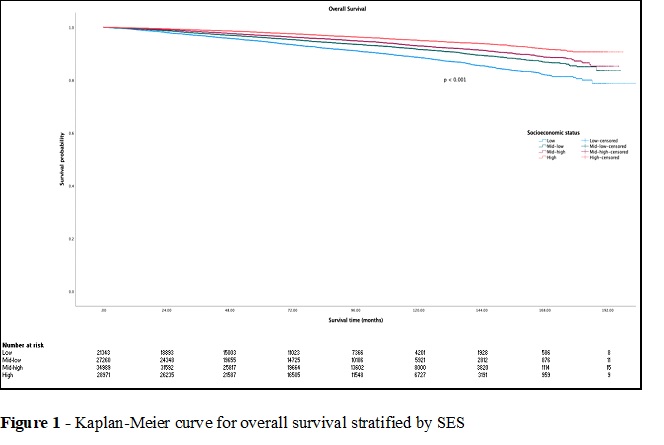
Introduction: Prostate cancer (PC) is considered a disease of older men; about 10% of new diagnoses in the US occur in men = 55 years old. Socioeconomic status (SES) has shown to influence survival in patients with PC; however, the impact of SES on men with early-onset PC remains undescribed. Methods: Using the National Cancer Database, we identified men = 55 years of age with PC between 2004-2018. Descriptive statistics were used to characterize differences among SES groups. Kaplan-Meier (KM) and Cox regression analyses were used to assess the effect of SES on overall survival (OS). To establish the impact of SES, the quartile assignments of median income and education level were combined to create a composite SES measure. Income and education level were determined by matching each patient’s zip code at the time of diagnosis with data derived from the 2016 American Community Survey on median household income and the percentage of people aged = 25 years old who had not earned a high school diploma, respectively. The quartile assignments (Q1, Q2, Q3, Q4) of the income and education measures were added together to form 4 composite SES categories: 2-3=Low; 4-5=Mid-Low; 6-7=Mid-High; and 8=High. Results: A total of 112,563 patients with early onset PC with a median follow-up of 79.0 months were included in the study cohort. Compared to high SES patients, low SES patients were more likely to be African American (42.4% vs. 8.6%; p<0.001), Hispanic (9.5% vs. 2.7%; p<0.001), and uninsured (5.2% vs. 1.1%; p<0.001); they were also more likely to live in a rural area (3.2% vs 0.1%; p<0.001) and have stage IV disease (5.5% vs. 3.1%; p<0.001). KM analysis showed that a decreasing SES was directly associated with lower rates of OS (log-rank test p<0.001). On multivariable analysis, SES was found to have a negative effect on OS (low SES vs. high SES; hazard ratio [HR] 1.54; 95% confidence interval [CI] 1.41-1.68; p<0.001) (Figure 1). Conclusions: In patients with early-onset PC, SES was associated with overall survival. SES should be considered when implementing programs to improve the management of patients with early-onset PC SOURCE OF Funding: none