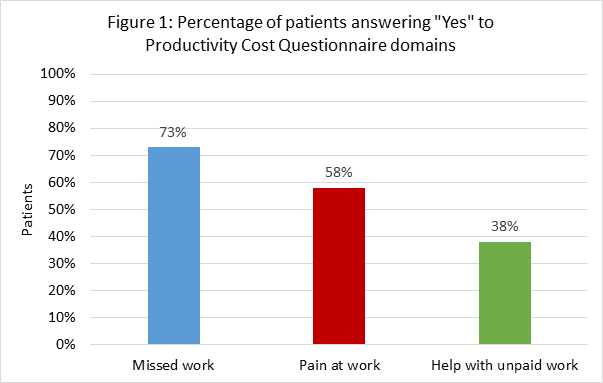
Introduction: Ureteral stones affect patients of working age and disrupt daily activities. Patient reported outcomes during trial of passage are understudied which hinders counseling and expectation setting. We sought to characterize work productivity losses for patients with a ureteral stone undergoing a trial of passage. Methods: We identified employed, English speaking patients aged 18-64 years and discharged from Duke University Health System EDs with unilateral ureteral stones on CT scan from February-October 2022. Patients were contacted by phone 4 weeks after discharge and administered the Institute for Medical Technology Assessment Productivity Cost Questionnaire which evaluates three domains of productivity loss over a four-week period: absenteeism (missed work), presenteeism (decreased productivity at work), and volunteerism (help with unpaid work or domestic tasks). Patients were designated as reporting passage of their stone if they noticed it in the toilet or identified a day with symptom resolution that did not return. Results: We enrolled 64 patients who completed the survey. 71% (46/64) had distal stones and 14% (9/64) had symptoms at the time of the survey. 73% (47/64) of patients missed work after discharge (Figure 1), missing a median of 2 days (interquartile range [IQR] 1.0-4.0). 58% (37/64) had pain at work, with a median of 3 days of pain (IQR 1.5-6.5) and a median of 40% reduction in productivity (IQR 20%-50%) on symptomatic days. 38% (24/64) required help with unpaid work for a median of 2.5 days (IQR 1.0-5.8) and median of 3.5 hours per day (IQR 2.0-5.0). 58% (37/64) of patients passed their stone with a median passage time of 3.5 days (IQR 2.0-7.8). Of patients who passed their stone, 68% (25/37) missed work, with a median of 2 days missed (IQR 1-2) or 50% of work days until their stone passed (IQR 21%-83%). Of patients who reported not passing their stone, 74% (20/27) missed work for a median of 4.5 days (IQR 1-7). This was a median of 14% (IQR 3%-22%) of days until surgery or survey completion. Conclusions: The majority of patients miss work during passage of a ureteral stone. While time off work is less than published rates after ureteroscopy, it is common to miss half of work days until the stone passes. This information may aid patient counselling and help to prevent return ED visits. SOURCE OF Funding: None