Session: MP16: Stone Disease: Epidemiology & Evaluation I
MP16-06: Machine learning-based decision support system to distinguish uric acid stones in patients with kidney stones of &[prime]grey zone&[prime] Hounsfield units: International multicenter development and external validation study
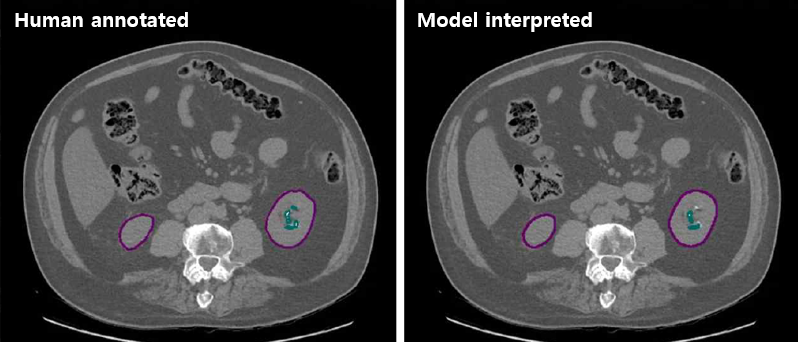
Introduction: Correct differential diagnosis of uric acid (UA) stones has important clinical implications since patients with a high risk of perioperative morbidity may be spared with surgical intervention. We developed and validated an autonomic decision-support system (DSS) to distinguish UA stones in patients with kidney stones of Hounsfield units (HU) <800. Methods: An international, multicenter, cross-sectional study was performed on 176 patients who received percutaneous nephrolithotomy for kidney stones with HU <800. Data from 136 (77.3%) patients were used for model training, validation, and testing (ratio 8:1:1), while data from 40 (22.7%) patients from a transnational institution were used for external validation. Demographic and clinical data consisted of 30 features potentially associated with stone component. A total of 14,843 kidney and stone contour-annotated computed tomography (CT) images were trained with the ResNet-18 Detectron2 Mask R-CNN algorithm to delineate renal anatomy and kidney stones and to measure stone features. Finally, the model was interpreted using the SHAP algorithm to enable visual interpretation of the association between the variables and model output. Results: There were no significant differences in baseline features between the development and validation cohorts. Our model was 100% sensitive in detecting kidney stones in each patient. The delineation of kidney and stone contours was precise within clinically acceptable ranges (Figure 1). The development model provided a predictive performance of 95.9% (92.9% sensitivity, 97.1% specificity). On external validation, the model’s prediction accuracy remained within a clinically acceptable range of 87.9% (66.7% sensitivity, 92.6% specificity). SHAP plots revealed stone density, diabetes mellitus, and urinary pH to be the top features for distinguishing UA stones. Conclusions: Our development and external validation study show that an automated DSS can conveniently identify and delineate kidney stones and distinguish UA stones from other component stones within the ‘grey zone’ Hounsfield units. Our DSS can be reliably used to select candidates for an earlier-directed alkalization therapy. SOURCE OF Funding: None.