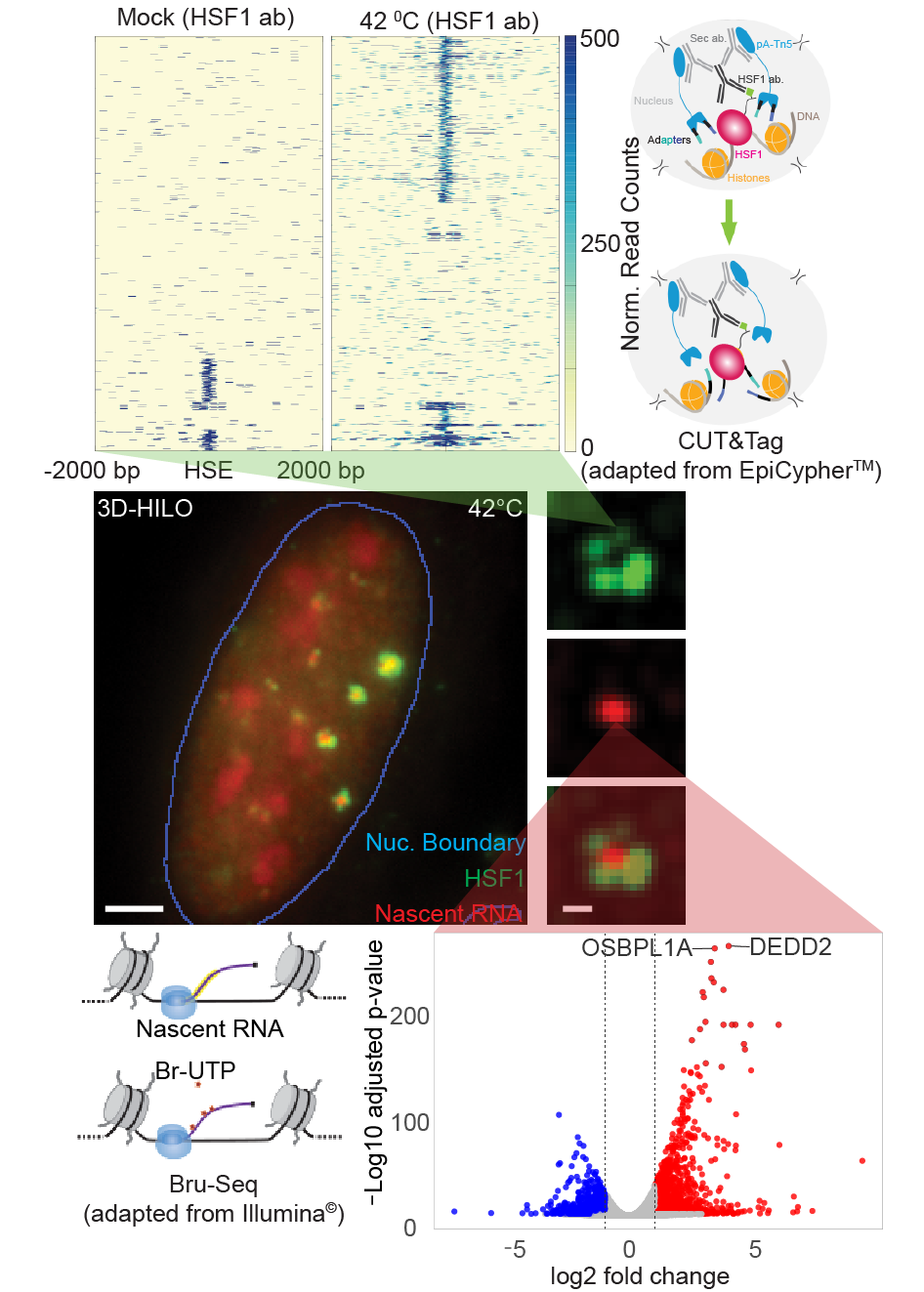
Introduction: Infertility affects one in six couples, with male factor contributing to ~50% of cases, wherein 30% of these men have idiopathic infertility. Several male infertility etiologies are thought to exert heat stress and impact spermatogenesis. Upon heat shock, mammalian cells invoke evolutionarily conserved corrective measures that include induction of chaperone genes by heat shock factor (HSF), a transcription factor, and concentration of RNAs and proteins within membraneless, subcellular granules. Investigations on how HSFs mount response to stress and how these granules impact spermatogenesis are lacking. We aimed to characterize these stress response mechanisms in cultured cell and murine models. Methods: We modeled various (e.g. heat, oxidative, hyperosmotic) stresses in human and mouse cell lines. Immunolabeling followed by super-resolution microscopy was used to visualize HSF granules. Metabolic RNA labeling coupled with Click Chemistry was used to visualize nascent RNA transcripts. Cleavage Under Targets and Tagmentation (CUT&Tag), an epigenomic technique, and Bru-Seq, a nascent transcriptomic technique, were used to probe HSF binding and newly formed RNA transcripts, respectively. Finally, we modeled acute (30 min) heat stress in mice and assessed testicular pathology by Johnson scoring. Results: All stresses induced the formation of nuclear HSF granules and these granules colocalized with nascent RNA. Strikingly, CUT&Tag showed that HSF1 had stress-specific genomic occupancy, even at chaperone gene loci, although Bru-seq revealed the generic upregulation of all chaperone genes in all stresses. In addition, we discovered stress-specific transcriptional programs, that modulate cell fate. Finally, the testes of mice treated with 42°C heat stress had lower spermatogenesis activity than control mice. Conclusions: Epigenomic, nascent transcriptomic, and super-resolution microscopy data has revealed that HSFs drive stress-dependent epigenomic and transcriptomic programs by forming stress-induced granules. Our findings pave the way to understand mechanistic drivers of male infertility and can identify biomarkers that stratify and possibly explain idiopathic infertility. SOURCE OF Funding: This work was supported in part by the UCF PSRTA, Dornier MedTech, and the UM Urology Catalyst and Incubator Awards.