Session: MP04: Kidney Cancer: Basic Research & Pathophysiology I
MP04-14: T Cell and B Cell Receptor Sequencing Reveals anti-cancer immune response associated with immune-related adverse events in advanced renal cell carcinoma patients treated with immune checkpoint inhibitors
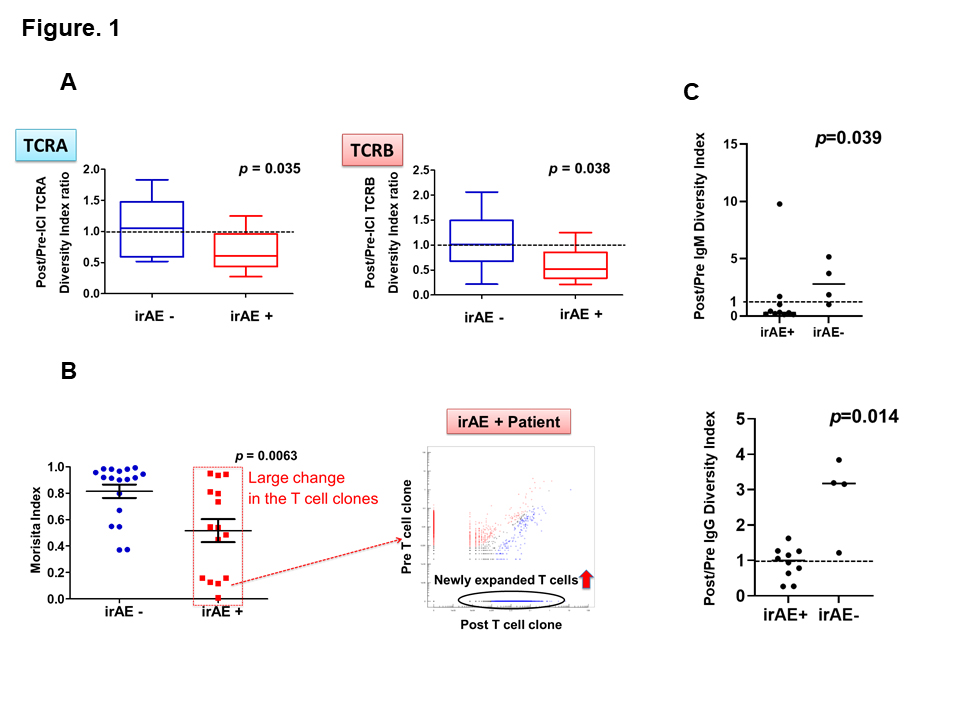
Introduction: Recently, several data are available on the relationship between immune-related adverse events (irAEs) and clinical efficacy in patients with immune checkpoint inhibitors (ICIs). In this study, we aimed to elucidate T cell receptor (TCR) and B cell receptor (BCR) repertoire in peripheral blood mononuclear cells (PBMCs) before and after ICI treatment, and at the onset of irAE for understanding of irAE-induced anti-cancer immune responses. Methods: We collected metastatic tumor tissues and peripheral blood samples from 56 patients with advanced renal cell carcinoma before and 1 month after anti-programmed cell death protein 1 (PD-1) treatment initiation. Furthermore, we applied a next-generation sequencing approach to characterize TCR and BCR repertoires using tumor tissues and PBMCs. Results: The number of irAEs was significantly higher in responder for PD-1 treatment (p < 0.0001). TCR repertoire analysis revealed that diversity index (DI) for TCR alpha and beta in irAE present patients were significantly decreased at 1 month after treatment, indicating expansion of certain T cell clones even in PBMCs after the treatment (Figure. 1A). We also examined morisita index to measure T cell similarity between pre- and post- treatment than irAE absent patients, indicating a larger change in the T cell clones, and inducing newly expanded T cells in post- treatment PBMC samples (Figure. 1B). Importantly, irAE present patients had significantly higher numbers of peripheral T cell clones shared with metastatic tumor-infiltrating T cells than those in irAE absent patients at 1 month after treatment (p=0.038). We also confirmed that DI for BCR IgM and IgG in irAE present patients were significantly decreased at 1 month after the treatment, indicating expansion of certain B cell clones (Figure. 1C). Conclusions: Our findings revealed that a certain number of irAE-induced T cell and B cell clones can circulate systemically and attack tumor cells synergistically in distant regions, leading to durable response in the patients with irAEs. SOURCE OF Funding: This work was supported by JSPS KAKENHI (Grant-in-Aid for Scientific Research (C), grant number 18K09133 and 21K09343.