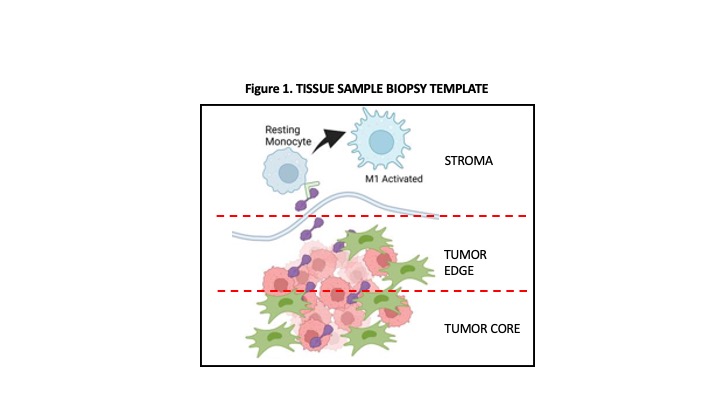
Introduction: M2 macrophage polarization (CD163) leads to T cell exhaustion and worse clinical outcomes in ccRCC patients. Recently, our group has identified a novel splice variant of RNASET2, a protein normally contributing to anti-tumor activity. This splice variant was associated with worse clinical outcomes in ccRCC patients. We set out to determine the expression patterns for M2 macrophages and RNASET2, and their relationship with the RNASET2 splice variant. We hypothesize that the splice variant leads to abnormal protein formation, allowing for a tumor microenvironment that favors growth. Methods: We obtained primary tumor samples from 75 patients with ccRCC. Tissue sections from these specimens were obtained from the tumor core, tumor edge, and stroma (Figure 1). IHC was performed, staining for RNASET2, M2 macrophage (CD 163), and markers for T cell exhaustion (TIM3, CD8). In addition, RNA sequencing data was utilized to identify the RNASET2 splice variant expression in all tumors. Expression patterns of these cellular markers were analyzed, and then stratified based on whether the tumor was splice variant positive (SV+) or splice variant negative (SV-) Results: Expression of CD163 was inversely correlated with expression of RNASET2 in the tumor core and tumor edge (Figure 2). Interestingly, SV+ tumors had overall higher RNASET2 expression. However, when relative extracellular to intracellular RNASET2 staining was compared, the SV- tumors possessed relatively higher extracellular expression. Finally, when evaluating expression as a prognostic indicator, we found that high co-expression of CD163 and RNASET2 led to worse overall survival relative to low co-expression. This was seen in the tumor (47 vs 138 mo, p<0.001), tumor edge (80 vs 174 mo, p=0.001) and stroma (15 vs 125 mo, p<0.001). Conclusions: This data represents the first evidence that a relationship exists between M2 macrophages and RNASET2 in kidney cancer. We have demonstrated through staining of patient tissue samples that high RNASET2 expression is correlated with low M2 polarization of macrophages, and vice versa. Furthermore, based on relative extracellular localization, SV- tumors are more effective at secreting RNASET2 to promote anti-tumor effect. SOURCE OF Funding: N/A