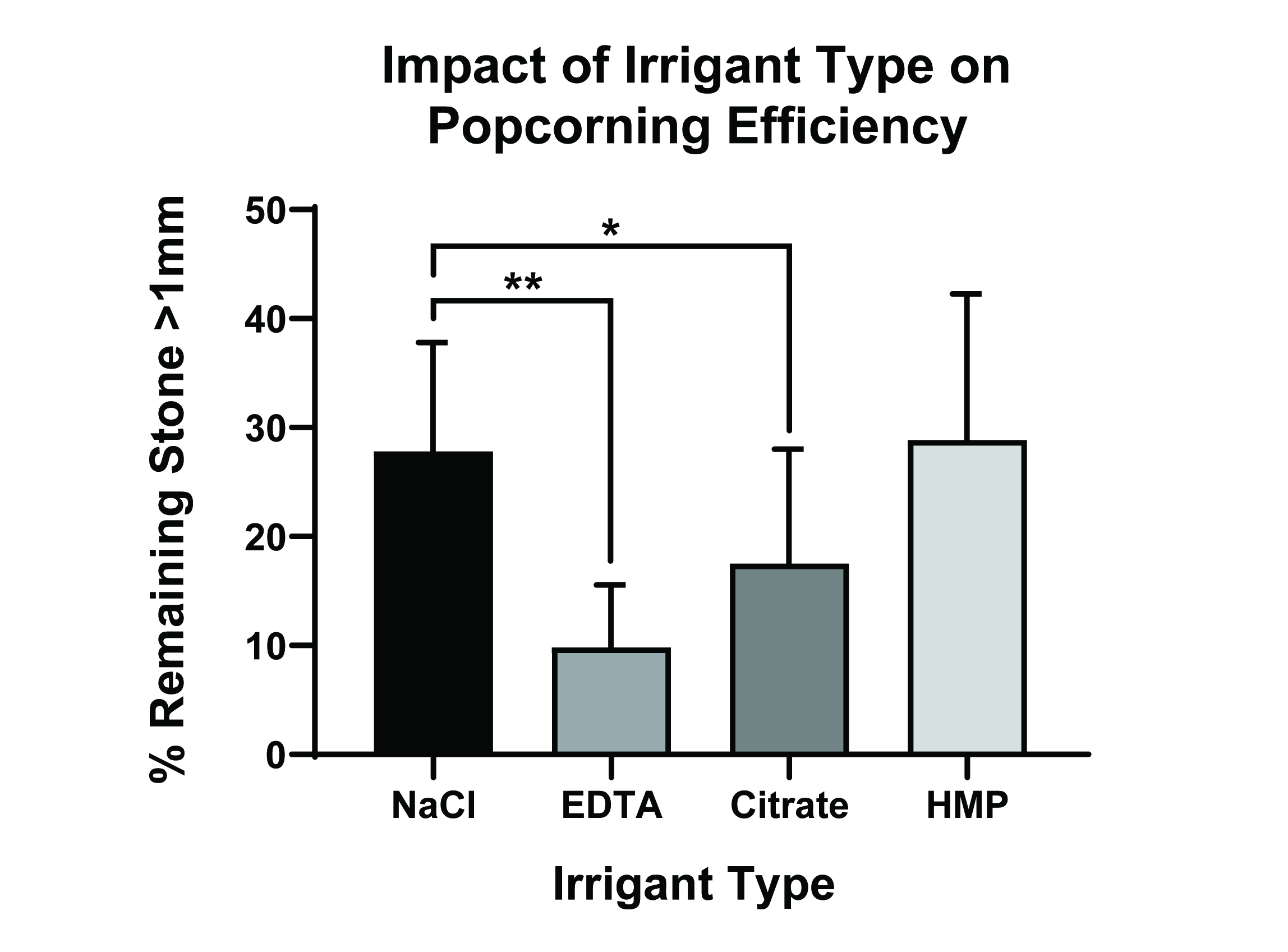
Introduction: The goal of popcorning or pop-dusting is to reduce stone fragments to submillimeter size, allowing spontaneous passage through the urinary tract. Polyanionic compounds can dissolve human calcium oxalate kidney stones. We explore the novel application of polyanionic solutions to enhance popcorning efficiency. Methods: BegoStones with matching size and mass were treated in a 12mm test tube calyceal model with a 60W TFL (SOLTIVE, Olympus). 200 mm fiber was introduced into our model calyx through a flexible ureteroscope and positioned 1-2 mm from the stones. Stones were treated at 1.0J x 40Hz for 4 minutes with irrigation at 30ml/min. We compared sodium chloride (NaCl), sodium citrate (Citrate), sodium hexametaphosphate (HMP), and sodium EDTA(EDTA) solutions. The osmolality of all solutions was matched to 0.9% NaCl. The pH for solutions of NaCl, EDTA, HMP, and Citrate was 6.0, 8.3, 6.7, and 8.6 respectively. After treatment, stones were passed through a 1 mm sieve and remaining fragments weighed. The primary outcome was residual stone mass >1mm. Results: The average remaining stone mass >1mm after 17 observations with NaCl irrigation was 27.8% (±10.0%). After 15 observations with HMP, Citrate, and EDTA irrigation, the average remaining stone mass >1mm was 28.9% (±13.4%), 17.5% (±10.5%), and 9.8% (±5.7%) respectively (Figure 1). HMP had no significant effect on residual stone burden compared with NaCl. There was a 37% reduction in residual stone mass when using Citrate compared with NaCl (p=0.008). Using EDTA reduced residual stone mass by 65% compared with NaCl (p < 0.001). Conclusions: Citrate and EDTA show promising results for enhancing the efficacy of popcorning in this in vitro model. Further testing will be required to determine effectiveness on different stone types and safety on urothelium in short duration. SOURCE OF Funding: Midwest Stone Institute