Session: MP06: Health Services Research: Quality Improvement & Patient Safety I
MP06-06: Single-use plastic waste in common endourologic cases: characterization of a growing environmental crisis and impact of possible interventions.
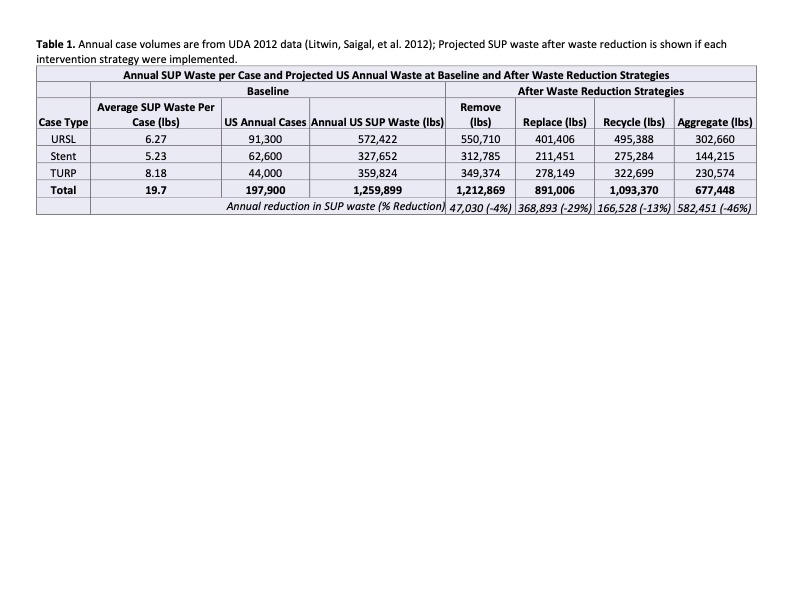
Introduction: Operating room waste is often in the form of single-use plastics (SUP), which contribute to landfill waste and ocean pollution and have been shown to have a detrimental impact on public health. We quantified the weight of SUP waste generated by three common endourologic cases—ureteroscopy/laser lithotripsy (URSLL), ureteral stent placement, and transurethral resection of prostate (TURP)—and projected annual SUP waste for these cases at a national level. We also estimated potential impact of waste reduction strategies: including removal of frequently unused SUP items from standard supply packs, replacement with reusable alternatives, and recycling. Methods: We prospectively sampled 20 URS/LL, 20 ureteral stent placement, and 20 TURP cases; then recorded used items in the EMR case supplies list and contemporaneously recorded unused SUP items in real time. Individual SUP items were weighed to create a standard metric. We projected our findings to annual case volumes at a national level using Urologic Diseases in America (UDA) 2012 data. We then modeled the potential impact of waste reduction by removing, replacing, and recycling SUP items based on current viable pathways. Results: Across our analytic sample of 60 patients, URSLL, stent placement, and TURP generated a mean (SD) of 6.27 (0.76), 5.23 (0.55), and 8.18 (0.68) lbs of SUP waste per case, respectively. Unused plastic waste for URSLL, stent placement, and TURP were 2.16 (0.78), 2.60 (0.62), and 0.73 (0.57) lbs per case, respectively. This amounts to a total of 1.3 million lbs of SUP waste annually. Removal of variable-use SUP items, replacing SUP items with reusable alternatives, and recycling SUP items by current potential pathways would reduce this number by 47,029 (4%), 368,892 (29%), and 166,528 pounds (13%), respectively, for a total SUP waste reduction of 582,451 pounds (46%) (Table 1). Conclusions: Common outpatient endourologic cases generate a substantial amount of SUP plastic waste, which has a negative impact on environmental and public health. Our field should take an active role in mitigating this health risk for future generations. Small changes such as removal of unused items from standard supply packs or replacement with reusable items can significantly reduce SUP waste. SOURCE OF Funding: .