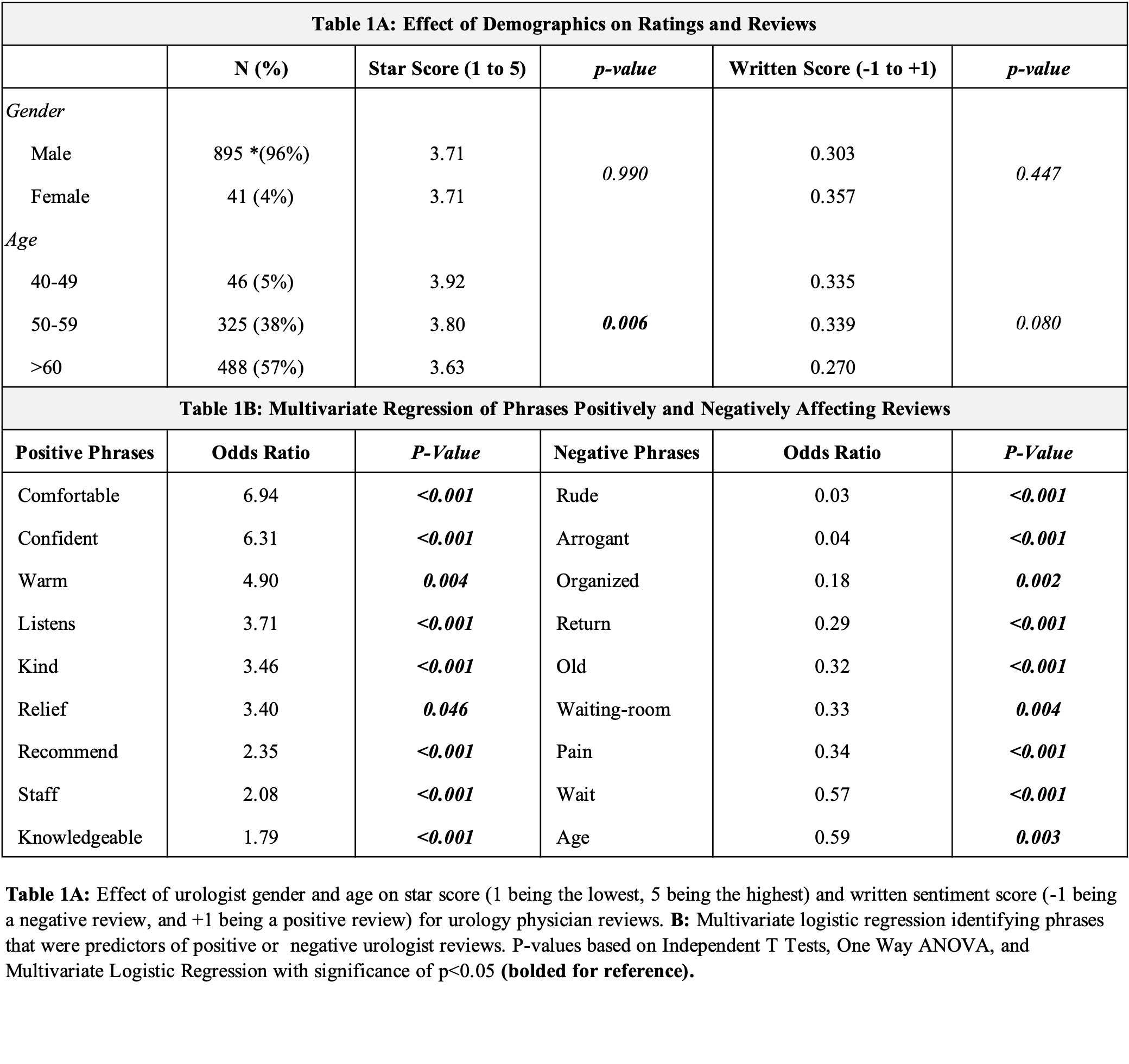
Introduction: Many patients use online physician reviews when considering their choice in providers. This study used quantitative and qualitative analysis to identify factors that affect the positivity of online reviews for urologists nationwide. Methods: The National Plan and Provider Enumeration System database was filtered for urologists, who were queried for written and star-rating reviews from healthgrades.com. Those without profiles or no written reviews were excluded. Sentiment analysis using the Valence Aware Dictionary and sEntiment Reasoner Python package analyzed physician gender, age, and specific key words from reviews to determine their impact on star-ratings (on a scale of 1 to 5) and written reviews (on a scale of -1 to +1). Results: Of the 1,854 urologists queried, 1,056 were included and a total of 6,606 reviews were analyzed. There was no difference in star, or written scores based on physician gender. Physicians over 60 years old had significantly lower star-ratings compared to those in the 40-49 and 50-59 groups (p = 0.006), with no difference in written scores based on age [Table 1A]. Multivariate logistic regression identified the phrases “comfortable” (OR: 6.94), “confident” (OR: 6.31), “warm” (OR: 4.90), “listens” (OR: 3.71), and “kind” (OR: 3.46) as the most significant predictors of positive reviews, while the phrases “rude” (OR: 0.03), and “arrogant” (OR: 0.04) as the most significant predictors of negative reviews. Addition terms such as “waiting room” (OR: 0.33) and “wait” (OR: 0.57) were predictors of negative reviews. Lastly, the phrase “pain” (OR: 0.34) was a predictor of a negative review, while the phrase “relief” (OR: 3.40) was a predictor of a positive review [Table 1B]. Conclusions: Older age, independent of other factors, is associated with more negative reviews. The strongest predictors of both positive and negative reviews were phrases related to the quality of the physician’s attitude and character. Long wait times and patients being in pain either prior to, during, or after the physician visit may lead to negative reviews independent of their experience with the physician. Physicians should be aware of these factors to provide the most positive clinical experiences and improve patient satisfaction. SOURCE OF Funding: NA