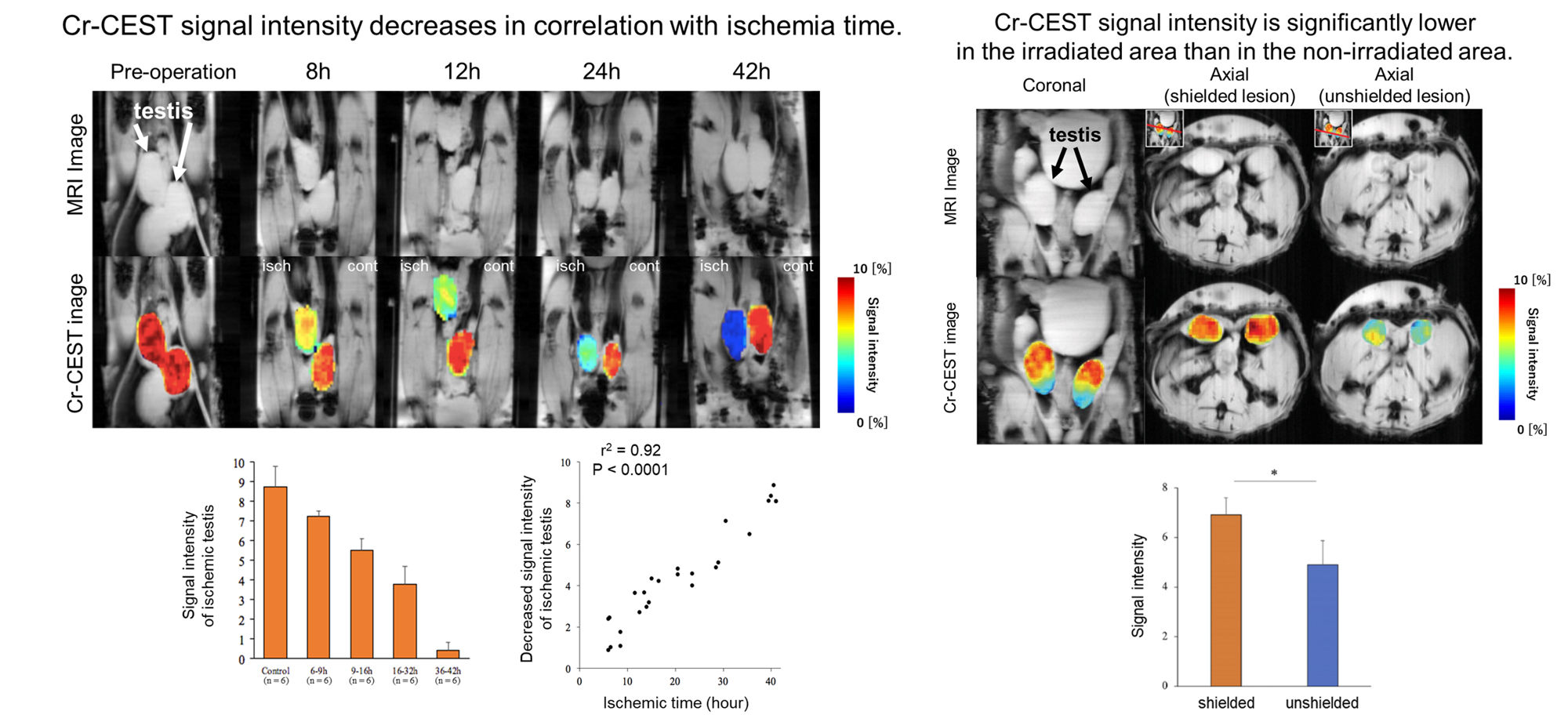
Introduction: The sperm retrieval rate in non-obstructive azoospermia (NOA) patients is still insufficient. To overcome this problem, an accurate noninvasive method of evaluating testicular spermatogenesis is needed. Chemical exchange saturation transfer (CEST) imaging is a new magnetic resonance imaging (MRI) technique that can image the distribution of trace substances in vivo. We focused on the potential role of creatine (Cr) in testes and hypothesized that Cr-CEST could indicate intratesticular spermatogenesis noninvasively. Methods: We investigated the Cr-CEST signal in the testes of the testicular ischemia model and the partial testicular irradiation model. In the testicular ischemia model, we clamped the right spermatic cord from 6–42 hours. To evaluate spatial resolution, we performed Cr-CEST for a partial testicular irradiation model in which the lower half of the testes was irradiated with a single 6 Gy dose. Results: In the testicular ischemia models, eight testicular ischemia models were serially imaged at two or three-time points and a total of 26 images of ischemic testis were obtained. The signal intensity of ischemic testis was significantly lower than that of controls (4.0 ± 2.0 vs. 8.9 ± 0.6, p < 0.01, figure). Correlation analysis revealed a strong linear correlation between the signal intensity decline and the duration of ischemia (r = 0.96, p < 0.01, figure). In the partial irradiation model, the signal intensity in the irradiated area was significantly lower than that in the non-irradiated area (5.3± 1.4 vs 7.6 ± 0.3, p < 0.05, figure). Conclusions: Cr-CEST noninvasively evaluate intratesticular spermatogenesis both qualitatively and spatially from this study. Cr-CEST would be used as feasible preoperative imaging for evaluating intratesticular spermatogenesis and a navigation system during microscopic intratesticular sperm extraction. SOURCE OF Funding: This research was supported by the Japan Agency for Medical Research and Development (AMED) (grant number: J210705035) and Grant-in-Aid for Scientific Research from the Japan Society for the Promotion of Science (JSPS) (grant number: A21H030670).