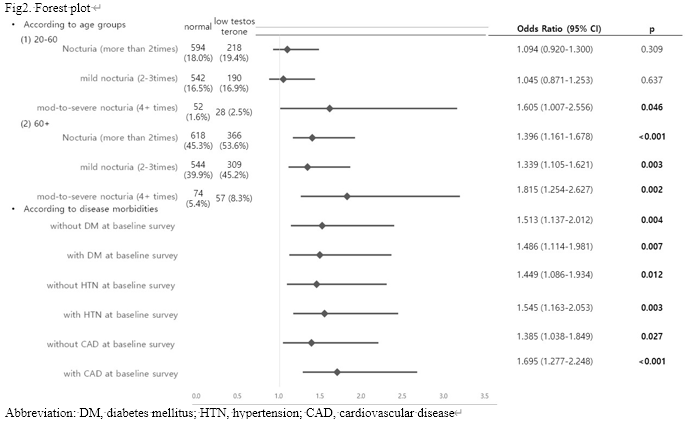
Introduction: Lower urinary tract symptoms (LUTS) are highly prevalent in elderly men and can be bothersome even in middle-aged population. Nocturia is closely related to sleep disturbance and negatively affect health by increasing the risk of morbidities. It is unclear whether testosterone deficiency affects worse outcomes in LUTS. Our purpose is to investigate the relationship between testosterone deficiency and nocturia. Methods: We collected data from the National Health and Nutrition Examination Survey (NHANES) 2011-2015. The study included 6,466 males over twenty years old. Decreased testosterone level was defined as less than 350ng/dL. We used reported symptom questionnaire to define nocturia as more than two times of voids per night. We categorized patients into two groups: mild nocturia (2-3 voids/night) and moderate-to-severe nocturia (more than 4 voids/night). Multiple logistic regression analyses were performed with adjustment for confounding variables. Results: Decreased testosterone level was confirmed in 1680 individuals (27.8%) and significantly associated with nocturia (Hazard ratio [HR] 1.358; 95% confidence interval [CI] 1.207-1.529). This tendency was more prominent in moderate-to-severe nocturia (HR 2.049, 95% CI 1.533-2.737). Using adjusted regression analysis, we found significant association between two variables in moderate-to-severe nocturia (HR 1.411, 95% CI 1.050-1.896) In subgroup analysis according to age, testosterone deficiency was significantly associated with nocturia in the group of ages over sixties. (HR 1.474 95% CI 1.218-1.782). Decreased level of testosterone was significantly associated with moderate-to-severe nocturia according to baseline morbidities. Conclusions: Decreased testosterone level was significantly associated with nocturia in men after adjusting for major confounding factors. This tendency was prominent in age group of more than sixties and group of moderate-to-severe nocturia. SOURCE OF Funding: The authors have no funding statement to this study to disclose.

.jpg "Sungjin Kim, MD photo")