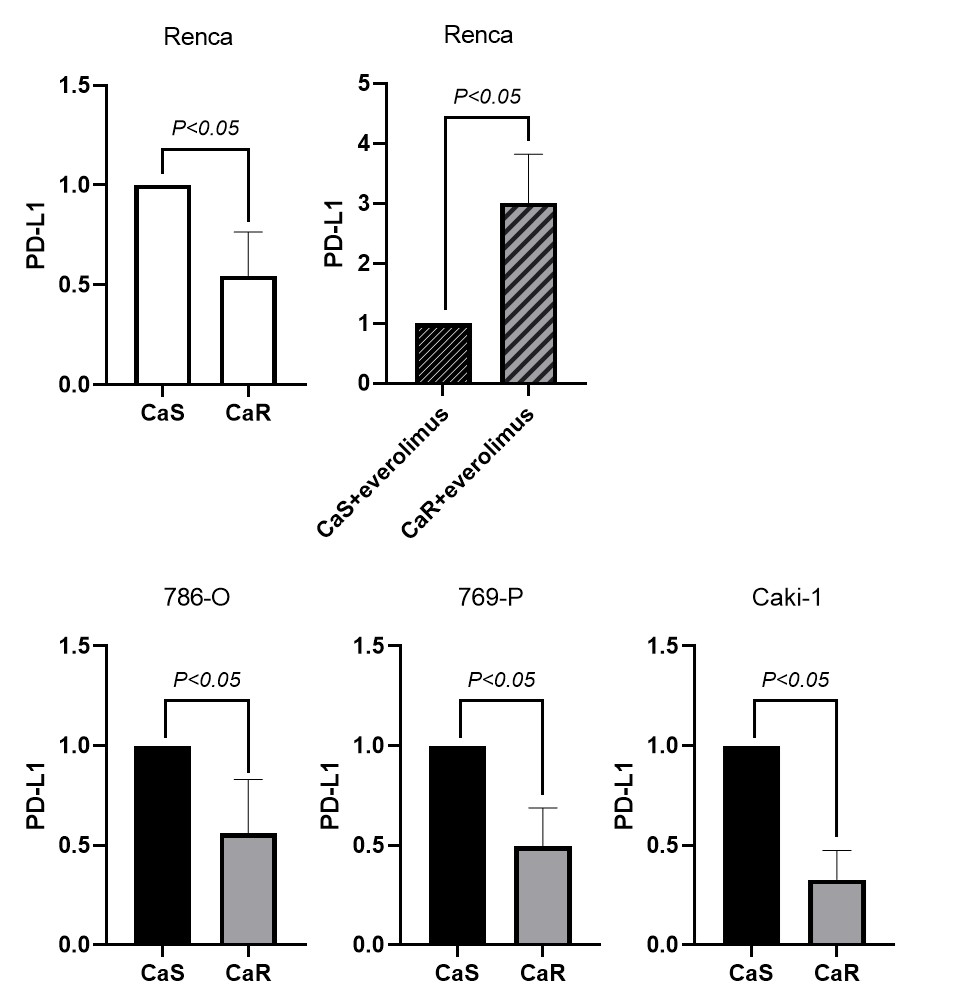
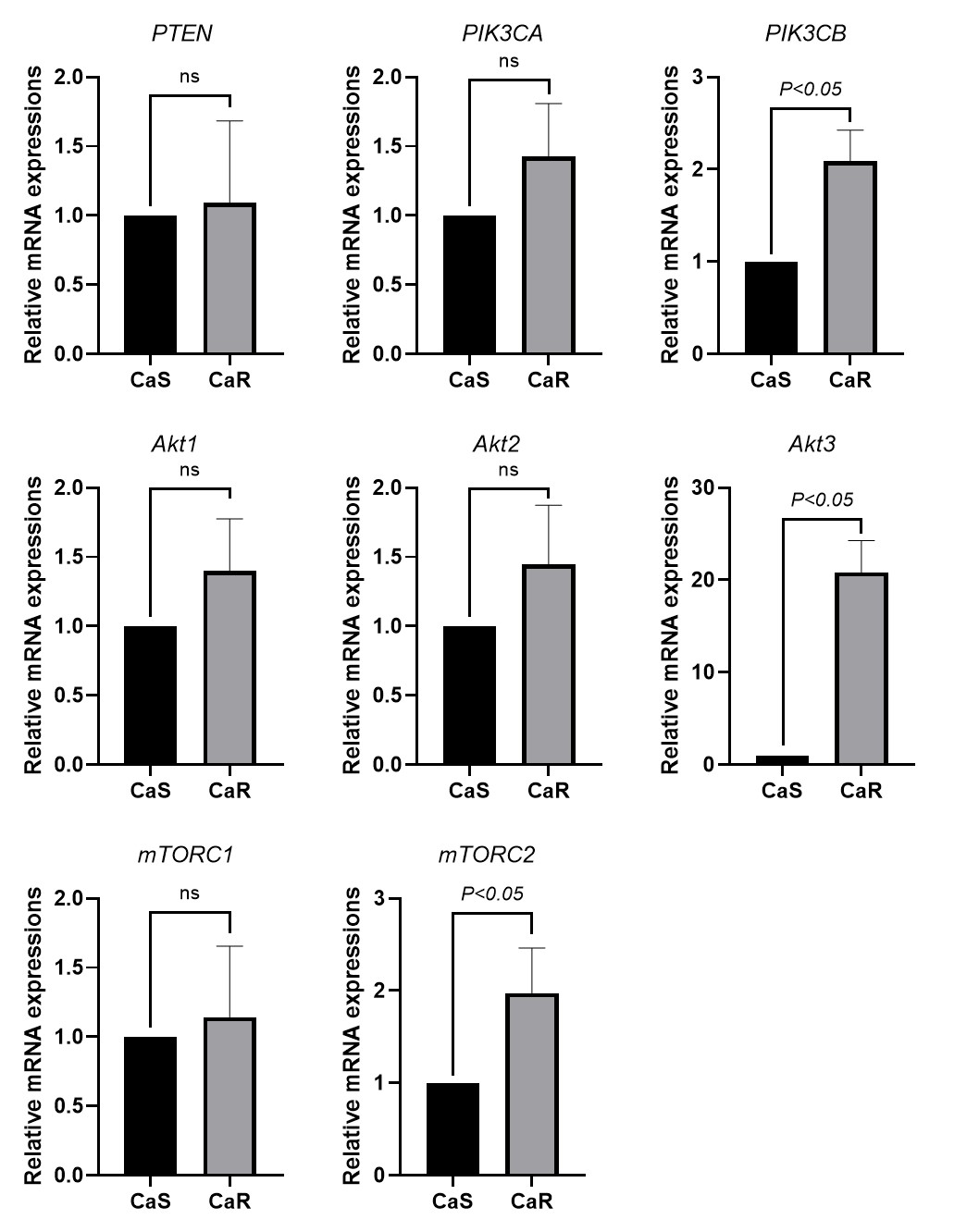
Introduction: Cabozantinib, a multitargeted tyrosine kinase inhibitor (TKI), is an important option for the treatment of advanced clear cell renal cell carcinoma (accRCC), used as the first-line setting for intermediate- or poor-risk metastatic ccRCC, when immunotherapy is not available. We explored the underlying signaling pathway associated with the cabozantinib resistance and provided the optimal sequencing. Methods: Cabozantinib-resistant RCC (CaR) cell lines were established by long-term treatment with cabozantinib. The mRNA expression profiles of PD-L1 and PI3K/AKT/mTOR signaling pathway proteins were investigated and compared in CaR and cabozantinib-sensitive (CaS) cell lines. Pulmonary metastatic orthotopic murine mRCC models have been developed with CaR Renca and CaS Renca. Mice were randomized and treated as 4 groups; 1) control (PBS treatment), 2) combination immunotherapy (anti-PD-1 and anti-CTLA-4 antibodies), 3) everolimus, and 4) sequential treatment of everolimus and followed by combination immunotherapy. Results: All CaR cell lines demonstrated significant decreased in PD-L1 compared to CaS cell lines (P <0.05). Furthermore, the mRNA expression of major PI3K/AKT/mTOR pathway members, including PIK3CB, AKT3, and mTORC2 were increased in CaR Renca compared to CaS Renca. Everolimus treatment significantly increased PD-L1 expression in CaR Renca compared to CaS Renca. For murine mRCC models, CaR Renca model demonstrated significantly increased primary tumor growth, but decreased pulmonary metastasis compared to CaS Renca model. The best therapeutic benefits were obtained in group 4. Conclusions: We showed that cabozantinib decrease PD-L1 expression, while increase PI3K/AKT/mTOR signaling. Furthermore, mTOR inhibitor increased the PD-L1 expression in CaR cell line demonstrating that everolimus followed by combination immunotherapy can be the best subsequent treatment in CaR accRCC. SOURCE OF Funding: This work was supported by a grant from the Korea Health Technology R&D Project through the Korea Health Industry Development Institute funded by the Ministry of Health & Welfare, Republic of Korea [grant number: HI17C1095], and the National Research Foundation of Korea (NRF) grant funded by the Korean government (MSIT) [grant number: 2019R1A2C1002863 and 2022R1A2C2003831]