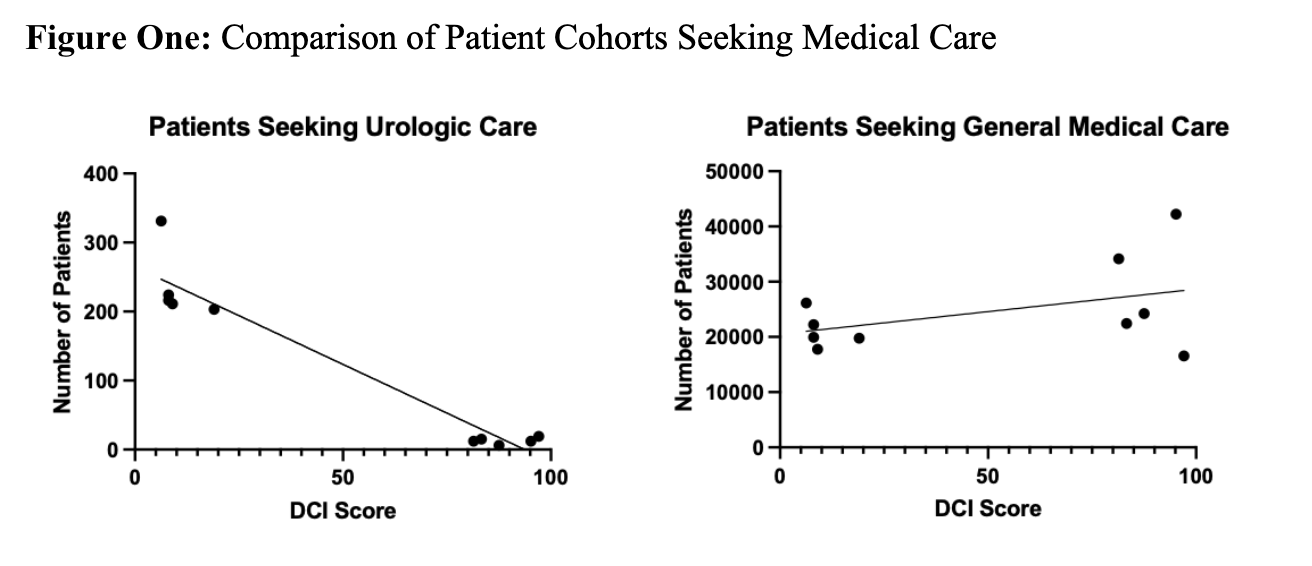
Introduction: Economic resources play a key role in the complex determinants of healthcare access. More specifically, the economic burden of healthcare proves to be a barrier for many seeking specialty care. Because of this, the objective of this study is to investigate the role of socioeconomic status as a determinant for electing urologic care among patients from a metropolitan area. Methods: Using the Distressed Community Index (DCI), disparate communities were identified by ZIP code within a ten-mile radius of our university hospital. The DCI compiles seven metrics regarding income, education, housing, and employment to generate a percentile score with lower scores indicating better economic well-being. We identified five zip codes that fall within the highest quintile of scores and five zip codes that fall within the lowest quintile of scores in order to provide a stratified patient cohort. Within these ten zip codes, we investigated the number of urology patients and general medicine patients seeking care for each identified zip code during the 09/01/2017 - 09/01/2022 observation interval. Correlation coefficients were calculated using SPSS. Results: Within the urology-specific population, there were 1185 patients residing within the low DCI zip codes and 64 within the high DCI zip codes; within general medicine, the number of patients were 105,863 and 139,575, respectively. When analyzing the DCI score in conjunction with urologic patients, the results show an incredibly strong relationship between DCI score of the zip code and the number of residents that present as urology patients: r = -.9596, R2 = .9208, p = .000011. Average income was also a strong predictor for urology patients: r = .8658, R2 = .7496, p = .001203. However, there was no correlation between general medicine patients and DCI score or income (r = .4283, R2 = .1834, p = .21687 and r = 0.3799, R2 = .1443, p = .278877, respectively). Conclusions: Our study has shown a clear correlation between socioeconomic status and demand for urologic care. This relationship emphasizes the need to prioritize efforts towards supporting increased access to urologic care in disadvantaged communities. Our findings establish the basis for further population-based studies addressing the role of socioeconomic status as a limiting factor to access urologic care. SOURCE OF Funding: None.