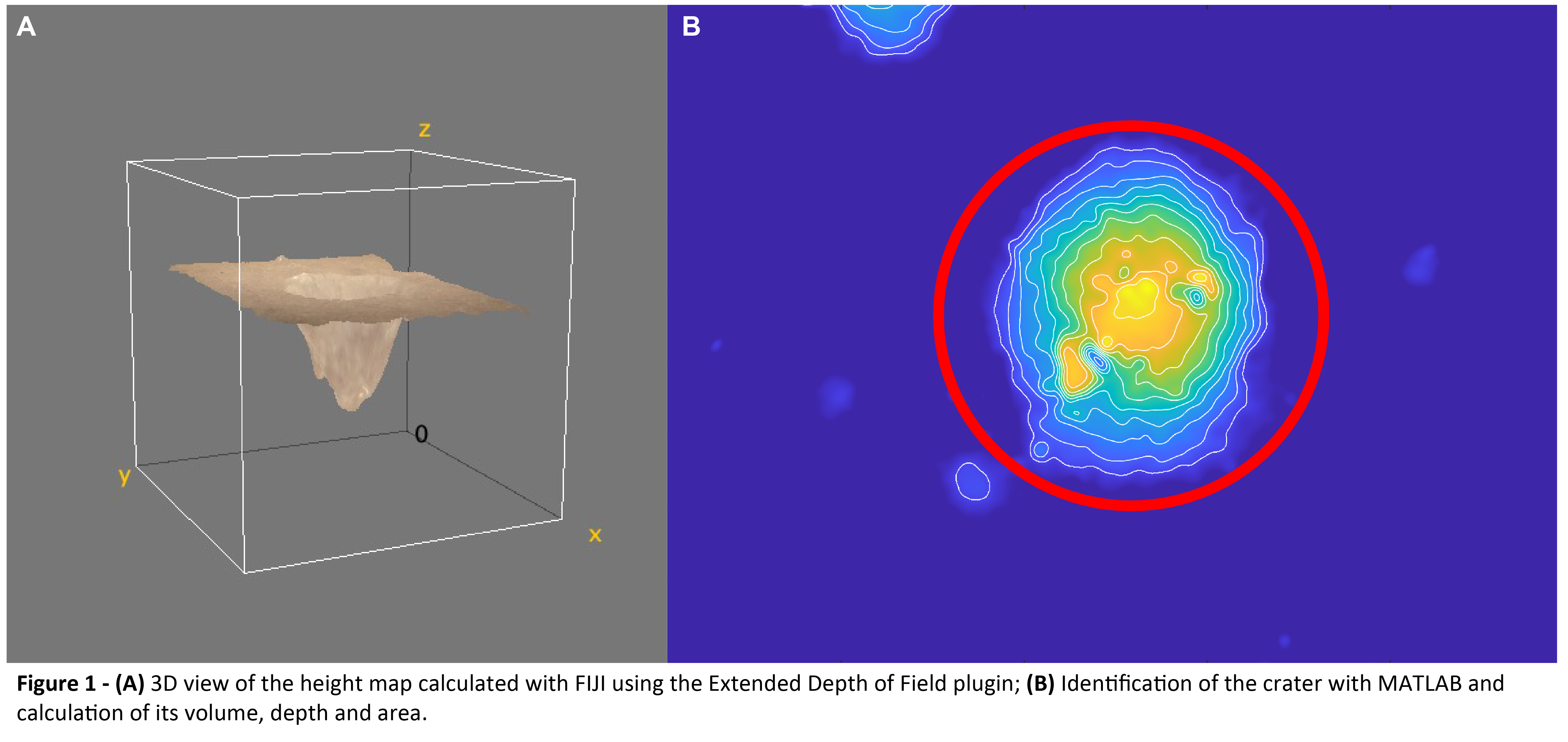
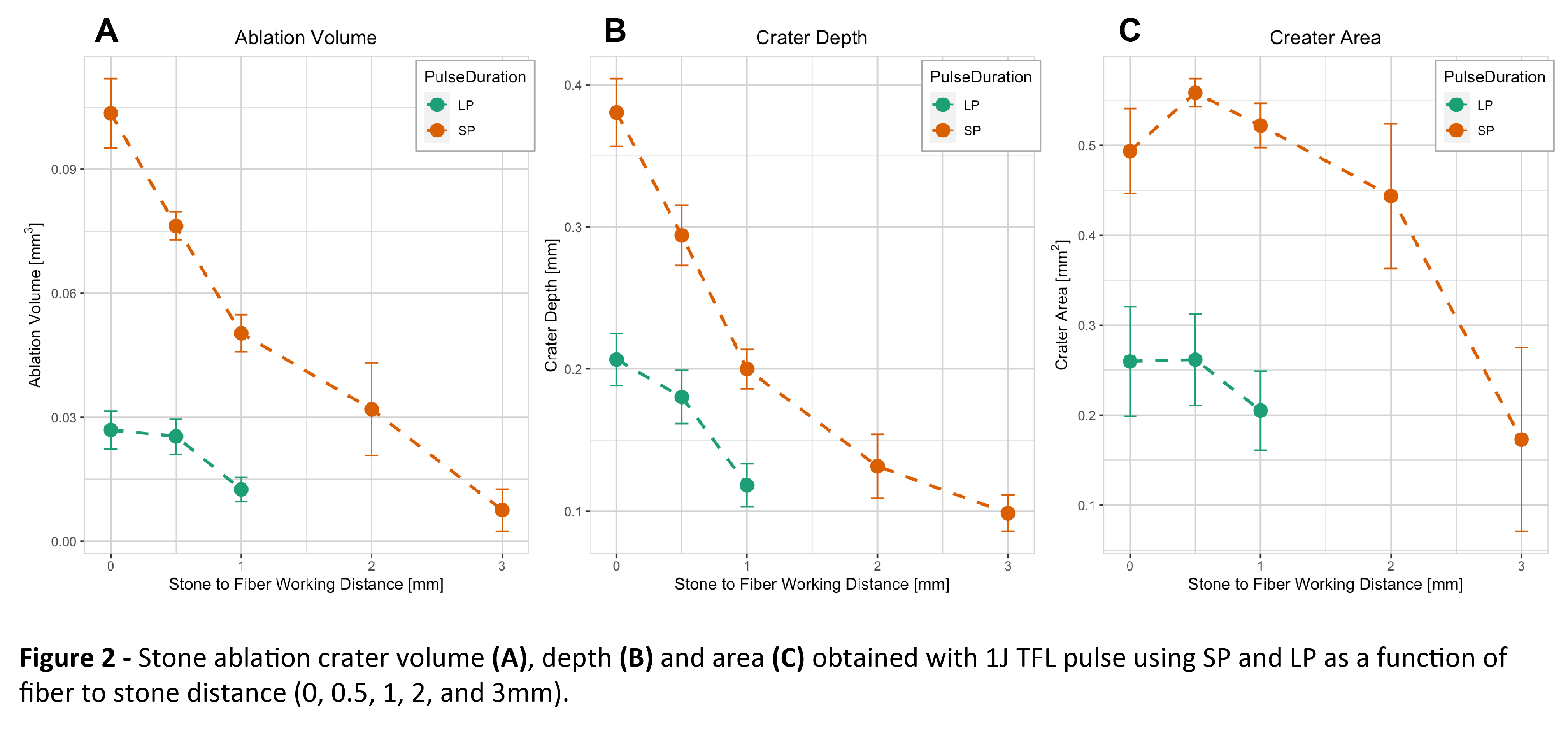
Introduction: The Thulium Fiber Laser (TFL) is a novel laser technology. Its wavelength has a higher absorption in water than the Ho:YAG laser, which could affect its ablative capabilities when working from distance. In this bench study, we assessed stone ablative crater characteristics of TFL at various pulse lengths and laser fiber to stone distances. Methods: Using a commercially available TFL (Fiber Dust, Quanta), a single pulse of 1J at the shortest and longest pulse durations (SP and LP) were delivered through a 200µm laser fiber placed at various distances from a flat BegoStone model using a 3D positioning system. Pulses were activated at 0, 0.5, 1, 2, and 3 mm from stone. 10 trials were performed for each pulse/distance combination; at least 4 trials had to result in ablation to be included. Each ablation crater was scanned using an optical microscope and a height map was calculated with FIJI using the Extended Depth of Field plugin (Fig 1A). The volume, depth, and area of the crater were calculated using MATLAB (Fig 1B). Statistical analysis was carried in R. Results: Both SP and LP exhibited a reduction in the ablation volume with increasing distance of the fiber from stone surface (Fig 2A). LP did not result in any ablation at greater than 1 mm distance. Ablation volume of 1J SP was larger than 1J LP for all distances (p < 0.00001) with up to 350% increased crater volume at contact. The same trend was seen for ablation crater depth with a mean depth of 0.38 mm and 0.2 mm at contact in SP and LP, respectively (Fig 2B). Surface area of the ablation crater was larger for SP at all distances; however, it showed different trend than volume and depth with a peak at distance of 0.5mm and then began to decline (Fig 2C). Conclusions: At 1J setting on contact, SP leads to at least three times more stone ablation volume in comparison to LP at contact. No ablation occurs with LP at greater than 1 mm distance. Further investigation is needed to understand why large differences exist between the same powered pulses at different pulse durations. SOURCE OF Funding: None