MP73-16: SUV variation on PSMA PET/CT correlates with biochemical response in patients with prostate cancer undergoing High-Intensity Focused Ultrasound (HIFU) focal therapy
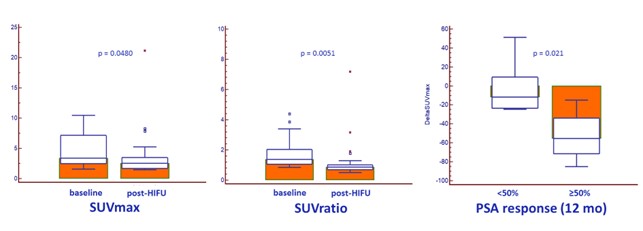
Introduction: Focal therapy (FT) for localized prostate cancer (PCa) offers minimally invasive localized ablative treatment while minimizing treatment-related toxicity compared to standard radical options. Recent advances in PCa imaging with PSMA PET/CT offer new opportunities to detect PCa foci and monitor response to treatment. The current study is designed to evaluate the role of PSMA PET/CT for response assessment in PCa patients candidate to High-Intensity Focused Ultrasound (HIFU) focal therapy. Methods: The present analyses was conducted in patients enrolled in an ongoing, prospective, single-center cohort study of patients treated with HIFU FT for localized PCa. Inclusion criteria: PSA <20ng/mL, radiological stage =T2bN0M0, ISUP grade 1-3, PSMA PET/CT at baseline and at response evaluation. Follow up included: PSA at 3, 6 and 12 months; PSMA PET/CT between 6-12 months post treatment. Biochemical response and PET response were statistically correlated: SUVmax and SUVratio to background of the target lesions were used as semi-quantitative parameters for PSMA PET/CT, together with their variations before and after HIFU FT (i.e. ?SUVmax and ?SUVratio). Results: Overall, 23 patients met inclusion criteria for the analysis. Median age was 67 years (IQR 63-72), initial PSA (iPSA) was 5.9 ng/mL(IQR 5.2-8.7) and prostate volume was 40 mL(IQR 35.8-50.8). ISUP score was 1 in 16 (70%) patients and 2 in the remaining 7 (30%). Median SUVmax and SUVratio before treatment resulted 3.4 (IQR 2.6-6.3) and 1.4 (IQR 1.1-1.8), respectively. At 3 months post-HIFU, 35% of the patients obtained a PSA response =50%; whereas at 6 months and 12 months, PSA responses were 35% and 36%, respectively. Median SUVmax and SUVratio post-treatment resulted 2.5 (IQR 1.7-3.4) and 0.9 (IQR 0.7-1.0), respectively, proving a statistically significant reduction compared to baseline values (p=0.048 and 0.0051, respectively). Median ?SUVmax -22% and ?SUVratio resulted-30%. There was a statistically significant correlation of ?SUVmax and PSA response at 12 months post-HIFU (p = 0.021) (Figure). Conclusions: PSMA-PET may be a useful tool for monitoring response in PCa patients undergoing HIFU FT. Moreover, the SUV variation can predict biochemical response at 12 months post-treatment completion. SOURCE OF Funding: None