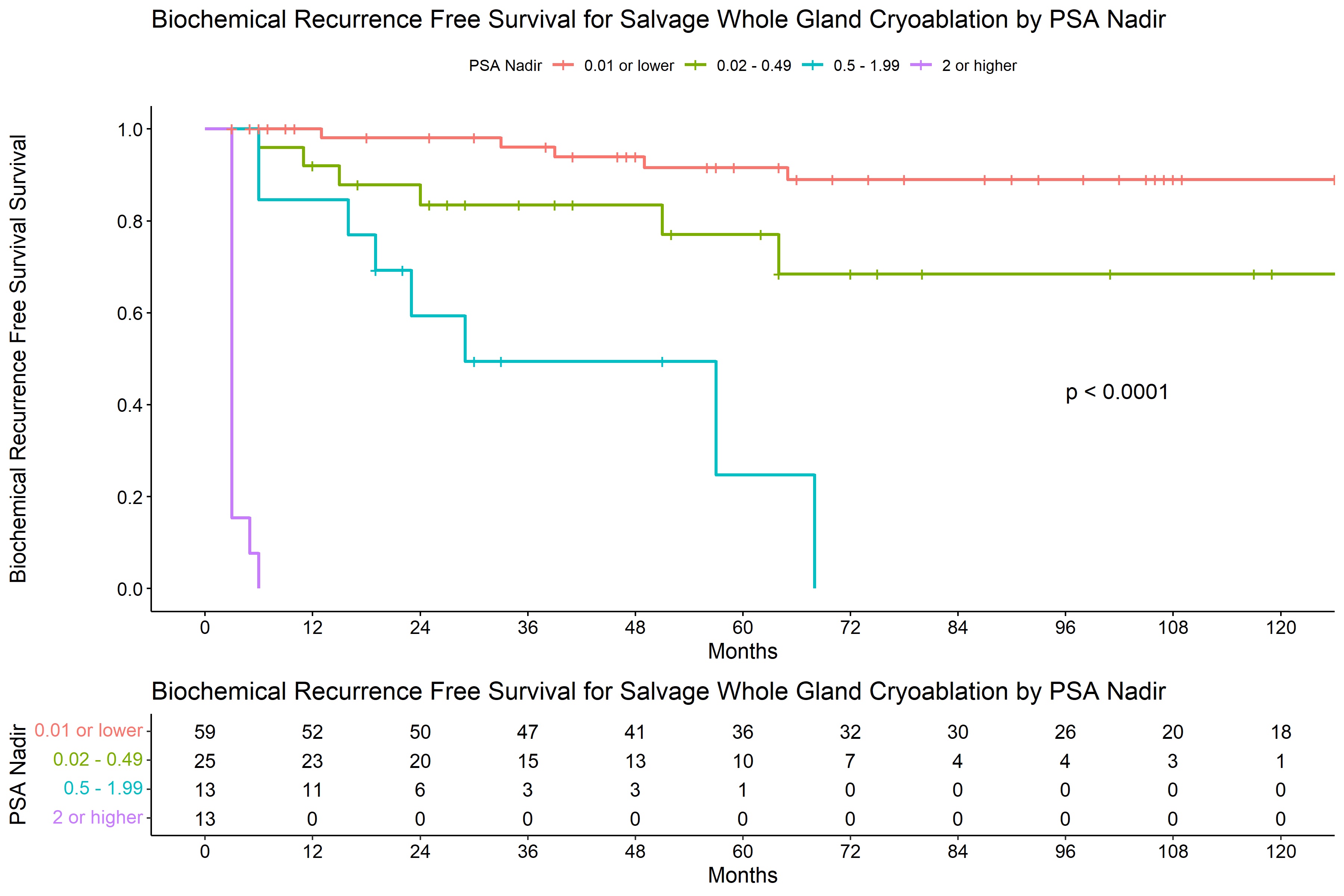
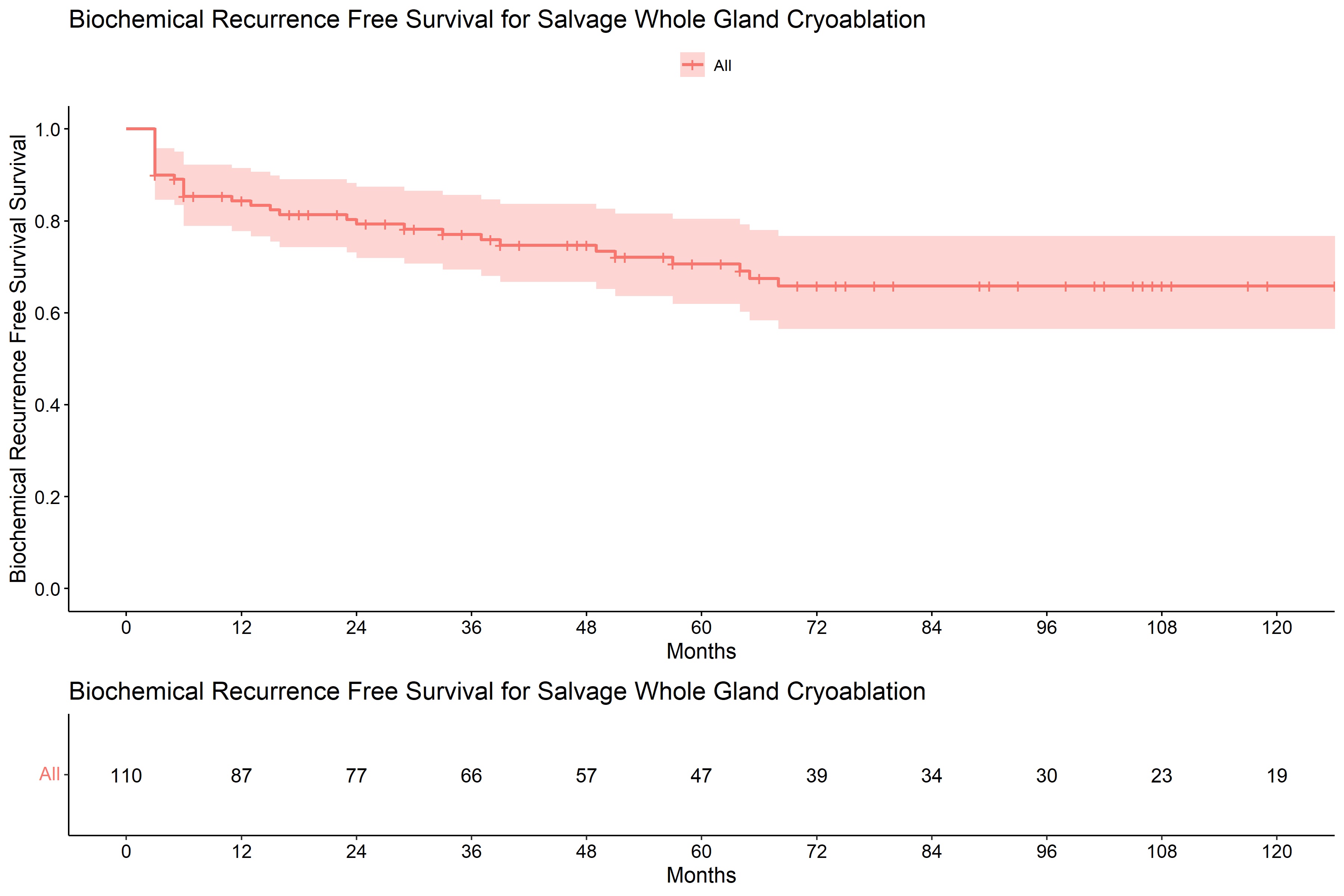
Introduction: We aim to report the oncological and functional outcomes in men who were treated with salvage whole gland cryoablation (SWGC) of the prostate for radiation resistant/recurrent prostate cancer. Methods: We retrospectively reviewed our prospectively collected cryosurgery database between January 2002 and September 2019 for men who were treated with SWGC of the prostate at a tertiary referral center. Primary outcome includes biochemical recurrence-free survival (BRFS) based off the Phoenix criteria. Secondary outcomes include metastasis-free survival (MFS), cancer-specific survival (CSS), and adverse events. Kaplan-Meier and multivariable Cox regression analyses were performed using a landmark starting at 3 months of follow-up. Results: A total of 110 men with biopsy-proven radiation-resistant prostate cancer were included in the study. Median follow-up was 71 months (interquartile range [IQR]: 42.3 – 116). BRFS at 2 years and 5 years were 81% and 71%, respectively. On multivariable Cox proportionate hazards analysis, we found that a precryoablation PSA of 4-10 ng/dL (HR 2.10, 95% CI 1.00 – 4.41) and PSA of >10 ng/dL (HR 4.26, 95% CI 1.35 – 13.40) to be associated with a lower BRFS. A higher PSA nadir was also associated with a lower BRFS. All patients with a PSA nadir of >0.5 eventually developed biochemical recurrence. Median IIEF-5 scores pre-cryoablation and post-cryoablation were 5 (IQR 1 – 15.5) and 1 (IQR 1 – 4), respectively. Stress urinary incontinence, strictly defined as requiring the use of any pads post-treatment, assessed at 3 month and 12 months were 5% and 9%, respectively. Clavien-Dindo =3 adverse events occurred in 3 (2.7%) patients. Conclusions: In the appropriate clinical context, SWGC can achieve excellent oncological outcomes with minimal adverse events in men with radiation-resistant localized prostate cancer. SOURCE OF Funding: NA