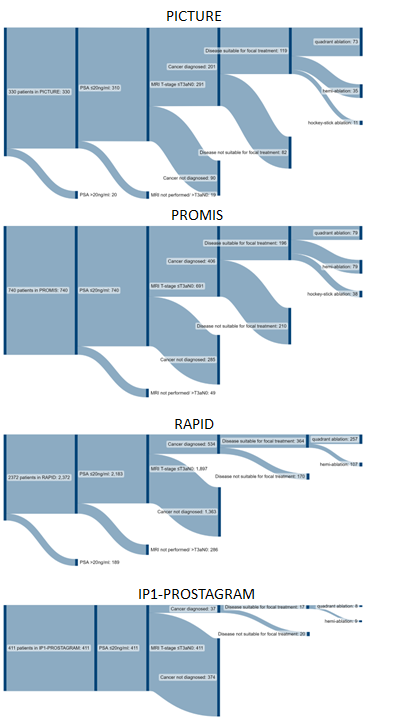
Introduction: Medium-term outcomes following focal therapy for non-metastatic prostate cancer demonstrate good cancer control. There is uncertainty about what proportion of patients might be eligible for focal therapy, given the shift to an upfront MRI in the diagnostic pathway. Using four large prospective studies (PICTURE, PROMIS, IP1-PROSTAGRAM and RAPIDOnline), we evaluated how many newly diagnosed patients might be suitable for focal therapy. Methods: Suitability was determined in a stepwise nature according to the Delphi Consensus criteria on focal therapy: PSA /=6mm, and treatment pattern must intend to spare at least 1 neurovascular bundle. Each study obtained local or external Research and Ethics approval. Results: 201/330 (61%) recruited into PICTURE were diagnosed with Conclusions: Independent of varying incidence of prostate cancer within each cohorts, once diagnosed with localised disease between 5 and 7 patients out of 10 were eligible for focal treatment. SOURCE OF Funding: n/a